

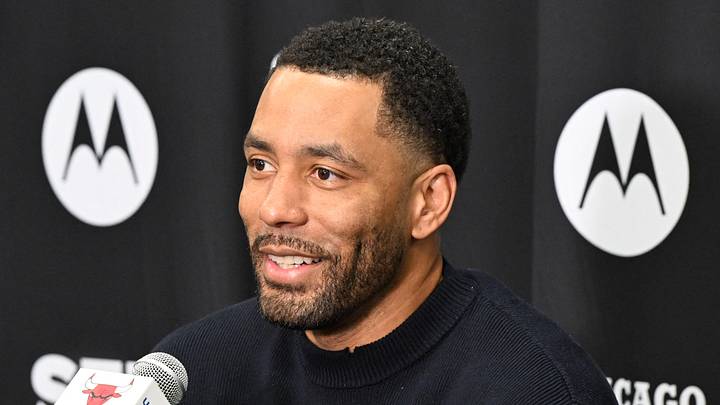
An NBA front office executive wears a lot of hats. Talent evaluator, salary cap enthusiast, franchise spokesperson, and on and on and on like an Erykah Badu song. The Chicago Bulls’ lead front office executive, Bryson Graham, is nearing the precipice of completing one-quarter of an unflattering 2026-27 NBA season in his maiden voyage running the franchise’s basketball operations.
Judging by Graham’s executive actions and rhetoric in Chicago, he’s kept a sparsely decorated coat rack in his Bulls office relative to the number of NBA executive hats he’s worn: spokesman for sure, flexibility enthusiast above most other things.
Graham’s basketball product is a wildcard, given the Bulls’ stinky start to the 2026-27 NBA season, which has recently morphed into coherent basketball in the absence of rookie Caleb Wilson.
15 games into this season, and certainly for the foreseeable future, there is one executive hat Bulls fans should look for and judge Bryson Graham’s job performance on: his ability to appropriately market his trade assets to generate profitable trade returns by the 2027 NBA trade deadline.
The Bulls need to win an NBA trade finally
A difference-making trade followed by improved on-court performances by the Bulls has not happened since the 2021 NBA offseason that ushered in former Bulls forward DeMar DeRozan.
Prior to that trade, the Bulls executed a dubious 2017 NBA offseason trade for the franchise’s last real NBA superstar, forward Jimmy Butler, which returned young, up-and-coming players in guards Kris Dunn, Zach LaVine, and forward Lauri Markkanen, but no future draft capital.
The Bulls historically have never been a destination for prime-aged, All-NBA-caliber free agents, and the franchise has also shot itself in the foot many times over by not maximizing draft lottery odds when the NBA implicitly incentivized teams to tank for better NBA Draft Lottery results.
Trades are the roster-building medium that the Bulls need to vigorously compete in order to advance the fortunes of a mostly losing NBA franchise throughout the 21st Century.
Graham’s Bulls legacy will be judged by his 2027 NBA Trade deadline
The bar is comically low for Bryson Graham to clear relative to his last two predecessors’ ability to win NBA trades. Again, John Paxson thrust the Bulls into a perilous rebuild with no surplus draft capital by shipping Jimmy Butler to Minnesota.
Arturas Karnisovas effectively depreciated the trade value of players like Zach LaVine, Alex Caruso, DeMar DeRozan, Coby White, and hometown favorite Ayo Dosunmu by holding onto those players for too long and getting replacement-level players and minimal surplus draft capital in return.
Graham is now presiding over at least a burgeoning trade market for guard Tre Jones and presumably a growing trade market for forward Jalen Smith. The luxury simply does not exist for Bryson Graham to play it safe and not cash in on either player at the 2027 NBA trade deadline. His Bulls roster is easily two seasons away from being two seasons away.
Fans can have separation anxiety about trading role players; NBA executives cannot.
Bryson Graham needs to set a reasonable trade price to capitalize on the demand other NBA teams are registering for his Bulls players and acquire assets to properly build his franchise into a winning basketball franchise again, if that is truly Graham’s primary motivation for doing his job.
 Add us as a preferred source on Google