

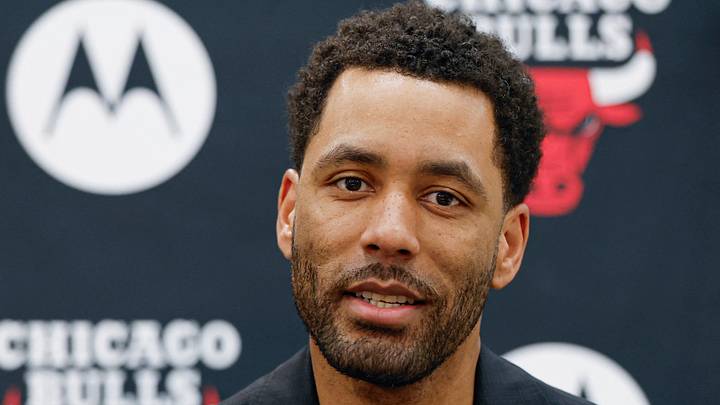
Perplexing is an understatement in describing the Chicago Bulls' second-round draft night decision-making in acquiring guard Kam Jones from the Indiana Pacers in exchange for guard Braden Smith via the 38th overall pick in the 2026 Draft, only to waive Jones approximately a week later, according to reports by Michael Scotto of Hoops Hype.
The Chicago Bulls plan to waive Kam Jones, league sources told @hoopshype. Jones had a deadline today that would’ve fully guaranteed his salary at $2.15 million. He was the 38th pick in the 2025 NBA Draft by the Indiana Pacers and was traded to Chicago on draft night.
— Michael Scotto (@MikeAScotto) June 30, 2026
It’s not the end of the world that Bulls lead front office executive, Bryson Graham, executed this series of underwhelming transactions, among otherwise great roster transactions, in his nascent administration of the Bulls' basketball operations department.
It is the beginning of the end of Graham receiving a blank check benefit-of-the-doubt in his Bulls roster moves.
The Bulls found their way to owning the 38th overall pick in the 2026 NBA Draft courtesy of receiving the pick plus guard Anfernee Simons from the Boston Celtics in exchange for trading center Nikola Vucevic and a 2027 second-round pick to the Boston Celtics. Simons is now an unrestricted free agent, so it’s quite possible that Simons’ time in a Bulls uniform is already over.
If the Bulls lose Simons in free agency and they sit without any net-new surplus draft capital after trading away the 38th overall 2026 NBA Draft pick, then Graham’s front office has a problematic lapse of asset management on their short Bulls management track record.
Does Bryson Graham have an optionality problem?
Having options is a virtue in the right context. Graham’s rationale for trading the Bulls’ 38th and 56th overall picks for minimal returns amounted to a desire to maintain roster and salary cap flexibility.
Why did the Bulls trade both of their 2nd-round picks Wednesday, including No. 38 overall?
— 104.3 The Score (@thescorechicago) June 25, 2026
Bryson Graham explains that none of the players on the board were targets of the Bulls.
"How can we get some future assets and push this pick forward?" he says. "That was the thinking." pic.twitter.com/37KYvhiHF2
In some regards, Graham’s expansive head coaching search also reflected a desire to maximize flexibility and maximize options. On one hand, flexibility is useful especially in ambiguous situations; however, what about when the goal or outcome should be reasonably clear?
The Bulls’ head coaching search may have had ambiguities that were rational to justify the list of candidates Graham interviewed up until he finally hired Tiago Spliter. What was so ambiguous about the second round of the 2026 NBA Draft that Graham and staff could not identify a single target in that round?
Has NIL watered down the caliber of talent available in the second round of the NBA Draft? Sure, and yet isn’t scouting what Bryson Graham is supposed to be expert-level great at? Graham was praised for the three years of scouting due diligence he committed on the prospect he selected 15th overall in the 2026 NBA Draft, Dailyn Swain.
Surely Bryson Graham’s scouting abilities translate to the second round of the NBA Draft. Hopefully, Graham is not planning on making a habit of using flexibility or optionality as his default justification for his decision-making. Because if that’s the case, he’ll quickly start sounding like his predecessor Arturas Karnisovas, in a song key that isn’t ‘continuity’.
 Add us as a preferred source on Google