

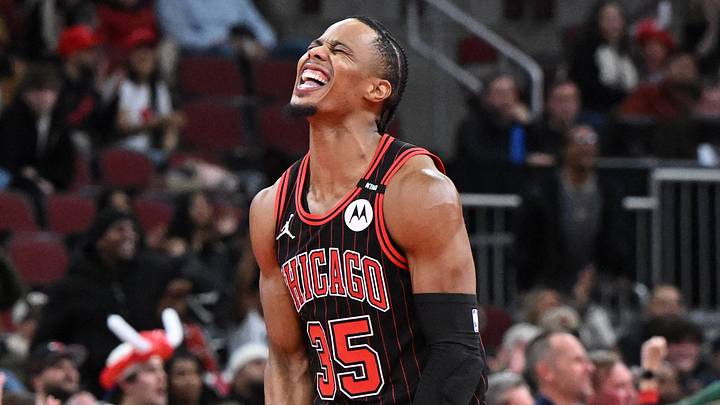
As Dec. 15—the date where players who signed contracts in the offseason are eligible to be dealt across the NBA—steadily approaches, it's not unreasonable to carefully monitor virtually every trade candidate on the Chicago Bulls' roster.
Both Norman Powell and Nic Claxton are movable pieces, and Powell's deal, particularly, is designed to be moved at some point this season in order to amass additional draft capital. The same goes for Zach Collins, although his value is likely significantly lower. And Chicago also has a number of expiring contracts—such as Jalen Smith's and Leonard Miller's—that could be leveraged toward the same end.
For players outside of Powell and Collins, the Dec. 15 date isn't a hard starting point. But it presents a rough date where teams around the NBA are willing to entertain deals. About two months into the season, most squads have started to get a full idea of where their needs and their flexibilities are.
And that means that Isaac Okoro, who's also on an expiring contract, is rounding into form at the perfect time for Chicago.
The Bulls need to maximize their assets on the trade market—and Isaac Okoro is giving them an opportunity to do so
With as bad as the Bulls have been outside of this recent stretch, it may seem rash to want to strip back the roster via trades. But this Chicago team doesn't need to be worried about competitiveness this season, even with the new NBA Draft Lottery rules. The goal should be, at the end of the day, to allow Bryson Graham and the rest of this new regime to shape the roster according to their vision.
And if the Bulls can grab some additional draft capital to help with that effort in the process, that's about the best they can do at this juncture.
Every player, then, outside of Caleb Wilson and perhaps Matas Buzelis should be on the table for the right price. The same goes for Okoro, and that price may quickly be rising.
The Bulls have a pretty solid idea of who Okoro is. He's never going to be a primary scorer, and he's not going to add much to his offensive game at this point. But he's been highly effective for Chicago since he entered the starting lineup in Wilson's absence, averaging 10.2 points, 3.8 rebounds, and 2.8 assists while knocking down 37.5% of his attempts from beyond the arc across those six games.
Now, six games isn't going to be enough to convince trade partners they're getting a knockdown shooter in a player that's converted just 32.2% of his 3-point attempts since joining Chicago before the start of last season. But there's plenty of evidence on Okoro's resume that indicates a higher upside there—he shot 38.3% from beyond the arc on moderate volume in his two seasons with the Cleveland Cavaliers before coming to the Bulls.
And with an expiring contract at just under $12 million, that shouldn't be a particularly hard sell for the front office.
As soon as the trade market heats up across the league, there will be teams entertaining the prospect of adding complementary defenders and perimeter shooters to their rosters. The Los Angeles Lakers seem to be in perpetual pursuit of those types of players, and teams like the Indiana Pacers and Miami Heat have current needs that could be filled by a player like Okoro. And if he can carry this stretch of viable perimeter shooting through the next couple of months, that makes him a more than viable candidate to be a trade target for those teams.
Now, we're likely not looking at a hefty return here—perhaps a pair of second-round picks or something along those lines. And the Bulls will need to seriously consider their depth on the wing if they're planning on also trying to move both Powell and Buddy Hield this season.
But the more options Chicago has over the next couple of months, the better. And Okoro is providing them with one based on his recent play.
 Add us as a preferred source on Google