

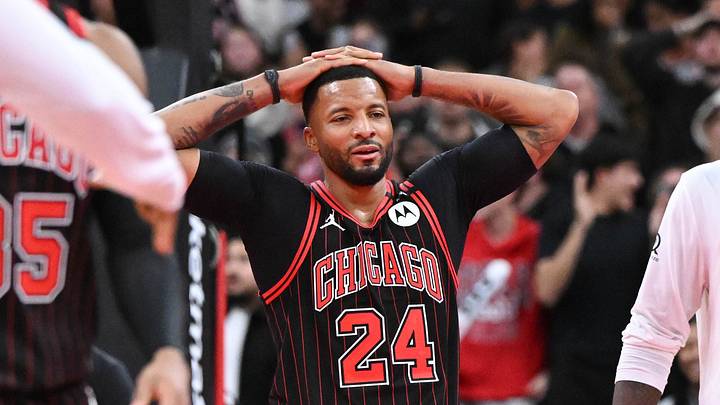
The Chicago Bulls are finally playing better, capping off a recent stretch of relatively solid play with a dominant, 137-107 victory last night over the Brooklyn Nets.
In a season where the team is trying to reset this roster and chart out a path forward under new head coach Tiago Splitter, these sorts of wins don't mean much substantially. But each player's individual performance—whether as a developing prospect or a potential trade piece—does.
And Norman Powell has been a floor-raiser for this Bulls roster across his first 12 games. That's not something that can be outright ignored.
Across his first 350 minutes this season, the Bulls are over six points better per 100 possessions with him on the court, and his ability to consistently hit his 3-point shots and command touches on the perimeter has paid dividends for the offense, especially now that Caleb Wilson's absence has made the fit look more seamless.
But at the end of the day, Powell's contract is designed to be traded, and that's going to be a real consideration as Chicago gets closer to Dec. 15—the first day that Powell is eligible to be moved this season. So do the Bulls trade Powell at the height of his value, at the cost of potentially jeopardizing any sort of tentative floor this team has established?
There's no easy answer to that question—but it's likely one that will be answered on the court.
If Caleb Wilson and Norman Powell can co-exist, then it's better to keep Powell around at least until the trade deadline
Again, Powell has been a solid starter in the backcourt for Chicago this season, averaging 21.3 points, 2.8 rebounds, and 2.4 assists while shooting 45.1% from the field. There's no question that he makes the team around him better when he's out there, and the gravity he commands especially makes life easier of Matas Buzelis, who's seen an increase in production since Wilson went down and Powell returned.
But the ultimate goal of this season, for Chicago, is to maximize the development of its young pieces. Early in the season, when all of Powell, Wilson, Buzelis, and Josh Giddey were in the starting lineup, it was clear that Powell's touches were drawing opportunities away from Buzelis and Giddey—and that his style of play didn't necessarily match the speed that Splitter was trying to implement around Wilson.
So the question becomes, if not simple, at least easily identifiable. Are the Bulls' young pieces better off with Powell in our out of the lineup?
From one perspective, it's easy to side with former option. The Bulls don't have another true option at shooting guard that can score the way that Powell does, and keeping that offensive infrastructure intact will allow Wilson and Buzelis more freedom to move in the frontcourt even if it draws away some of their touches. Chicago is measurably better with Powell on the court this season, and there has to be some baseline of competitiveness if Splitter is going to get his young pieces to buy into the program.
The Bulls also aren't just limited to trading Powell at the deadline. Although trading him this offseason would require picking up his team option—lowering his value on the trade market to a team looking for flexibility—his $22.5 million salary for next season should still be relatively movable when the time comes.
But the real test will be when Wilson returns to the fold. To this point in the season, the Bulls have a -11.9 net rating with both Powell and Wilson in the fold, and it's likely that running more of the offense through Buzelis and Giddey in complement with Wilson could fix some of those schematic issues. Through 113 minutes with just Wilson on the court, though, Chicago has a -21.0 net rating. Wilson is still projected to be out for roughly another month with his hand injury.
That puts Wilson's return right around Dec. 15, but it also gives the Bulls plenty of time before the trade deadline to evaluate that on-court fit with a more extensive sample size. Does Powell make Wilson's development easier, or does the combination of those players result in a return to sub-par play for the team as a whole?
If it's the former, keep Powell around as long as it makes sense organizationally. If it's the latter, it's easy to guess which of those two players is going to be moved.
 Add us as a preferred source on Google