

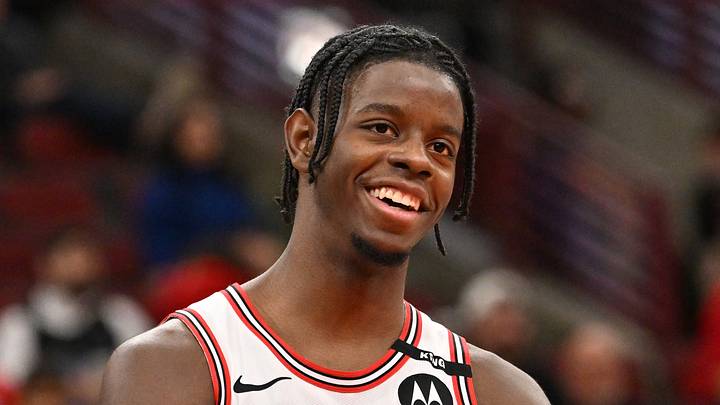
The Chicago Bulls started the 2026-27 regular season at 1-9. That made the loss of franchise player Caleb Wilson in game 10 a brutal pill to swallow, as it seemed as though any hope of a turnaround was lost. With Wilson on the sidelines, however, Chicago has won back-to-back games over postseason hopefuls in the Atlanta Hawks and Minnesota Timberwolves.
Though that may seem like a cause for concern, it's actually just a reflection of the inevitability of inconsistency when a team is running its offense through a rookie.
Their 1-9 start may have suggested otherwise, but the Bulls are a talented team. They're also a team that played two of their first 10 games without marquee signing Norman Powell and each of their first nine without signature trade acquisition Nic Claxton.
With Powell, the team's most proven scorer, and Claxton, arguably the team's best defender and playmaking big, back and generally healthy, Chicago has inevitably improved as a team.
The other element at play further fits the theme of inevitability: Wilson being destined to face a learning curve as a first-year player. With respect to AJ Dybantsa, Wilson isn't on a Washington Wizards side with two All-NBA teammates in more prominent roles. Instead, he's being thrown to the wolves on a team that's asking him to carry the offense.
With Chicago suddenly running its offense through players who already know the ins and outs of playing and even winning in the NBA, the team has looked better. Don't be fooled by the development.
Chicago is winning without Caleb Wilson, but he's still the future
Suppose Wilson is demoted in his role once he returns from undergoing surgery on his hand. He plays off of Powell, the team's leading scorer in both games that Wilson missed, and Chicago potentially makes a run that puts them closer to .500.
That sounds fantastic on paper, but what happens when the Bulls revisit the theme of inevitability and trade Powell around the February deadline?
Powell may be an All-Star in his extended prime, but he's also a 33-year-old sharpshooter with over a decade in the NBA and 91 games of postseason experience. As such, one can't help but wonder if he's actually interested in spending the final years of his athletic peak on a rebuilding team that would call reaching the Play-In Tournament a successful outcome.
One look at his contract seemingly reveals his and the Bulls' intentions, as he signed a two-year deal with Chicago that includes a second-season team option.
The Bulls starting to win games may not change Norman Powell's future
That may seemingly give the franchise the control, but such a structure is similar to what Jonathan Kuminga signed with the Golden State Warriors in 2025. The purpose of Kuminga's deal: Facilitating a trade to a team that better suited him.
One can't help but wonder if Powell's two-year contract with a second-season team option was structured for a similar reason.
Yes, there may have been teams who were reluctant to sign Powell to a long-term deal due to the fact that he's a 33-year-old guard. He was an All-Star in 2025-26, however, and the critical context of his deal is that few teams had the financial flexibility to give him the money he seemingly wanted.
With this in mind, it's entirely possible that Powell and the Bulls designed his contract in a way that would convince his next team that he could be acquired without risk via trade. Such an outcome would ideally enable Chicago to secure draft compensation and perhaps even a quality player.
It would also send Powell to a team that's aiming higher than the Bulls are at the moment. Most importantly, it would put Wilson right back in the No. 1 role.
A rookie has a learning curve that veterans already passed
All of this brings us back to the same point: A team running its offense through a rookie is likely to find less success than one operating through a veteran. The veteran scorer simply knows where their spots are on the court and how to get to them when everything seems to be failing.
Wilson is showing tremendous poise and determination relative to his age and inexperience, but he simply hasn't played enough NBA games to know what a veteran like Powell may—let alone to refine his skill set to an All-Star level.
Even still, he's No. 1 on the Bulls in field goal attempts per game at 16.2. At the time that Wilson went down, Powell was No. 2 at 12.9. In the two games since Wilson's injury, Powell has attempted 19 shots in each outing, scoring 33 and 24 points.
It's also worth noting that Powell was shooting at a clip of .398/.309/.797 before his own two-game absence preceded Wilson's injury. Had he not struggled so mightily, perhaps Chicago's record would've been better.
Caleb Wilson's growth is the most important focal point
With all of this established, and no one else on the Bulls showing the assertiveness required for the No. 1 scoring role, all roads lead back to Wilson. Perhaps that will result in fewer wins, but considering Chicago's ceiling and Powell's trade destiny, that's easy to justify.
Wilson isn't, after all, a short-term player whose value will be decided by what he does in 2026-27. He's the face of the franchise who's being trusted to grow and evolve over the next decade-plus.
If Wilson's experiences in 2026-27 make him a better player moving forward, then everything else will have been worth the struggle. He's already proving to be a skilled volume scorer who's willing to take the toughest shots, as well as an energetic defender who can help anchor the efforts on that end.
The Bulls may ultimately win at a higher clip without Wilson than with him, but if the goal is to climb out of the depths of mediocrity, then prioritizing the rookie is a necessary step.
 Add us as a preferred source on Google