

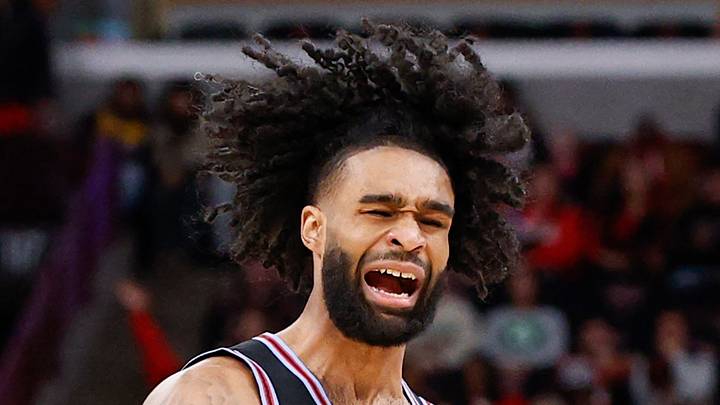
Coby White has been working his way back from a preseason calf strain by scoring at an absurd per-minute clip in recent games. Though it may be a small sample size, White's work on a minutes restriction is enough to remind the Chicago Bulls that they never should've traded him.
Re-signing White could've proven challenging, but had they invested more time and resources in his development and long-term fit, he could've made Caleb Wilson's life significantly easier.
The Bulls currently rank No. 26 in the NBA in offensive rating, No. 25 in field goal percentage, and dead last in three-point field goal percentage. White, meanwhile, has returned from the calf strain and put up numbers in a hurry. That began when he tallied 10 points and nine assists in just 20 minutes against the Cleveland Cavaliers.
White then scored 21 points in 20 minutes against the Phoenix Suns and another 21 points in 20 minutes against the LA Clippers. He shot 51.7 percent from the field along the way.
Both performances were reminders of how dynamic he can be on the offensive end of the floor. They were also games that threw salt in the wound of Chicago devaluing White while he was on the roster, trading him for just second-round draft picks and rental players, and ultimately drafting a player who could've worked well with White in Wilson.
Had the Bulls actually invested the necessary time in White's development, perhaps they could've re-signed him and given Wilson a scorer he can trust in 2026-27—and beyond.
Coby White was a reliable volume scorer when Bulls actually featured him
White's tenure with the Bulls was one of the most polarizing in recent franchise history. He consistently displayed the ability to not only put up impressive numbers, but contribute favorably to winning when featured in a prominent role.
Unfortunately, Chicago's fixation on making the DeMar DeRozan, Zach LaVine, and Nikola Vucevic trio work prevented White from actually playing the role that suits him.
It's a shame, really. In 2023-24, the Bulls went 10-15 when LaVine played and 29-28 when he didn't. When he played just seven games between Nov. 30 and the end of the season, it was White who stepped up with averages of 20.8 points, 5.5 assists, 5.1 rebounds, and 2.7 three-point field goals made on .453/.374/.839 shooting.
White's play directly coincided with Chicago's success as a team, as they found consistent offensive production from a co-starring player without having to necessarily run the offense through them.
Bulls should've given Coby White the green light before it was too late
The following season, Chicago traded LaVine and cleared a path for White—or so it seemed. The Bulls were 20-27 when LaVine played his final game for the team. They went 19-16 the rest of the way, with White averaging 22.9 points, 4.2 assists, 4.0 rebounds, and 2.8 threes per game on .470/.378/.922 shooting.
Unfortunately, White never truly got the green light to become a featured piece of the offensive puzzle and a trade ultimately became an arguable necessity due to the unlikelihood of him re-signing.
As White has proven throughout his tenure with the Charlotte Hornets, however, there was so much more for the Bulls to work with than they seemed to realize. He's a gifted scorer who can operate at all three levels, as well as an unselfish player who can work both with and without the ball.
For a Chicago side that's looking to build through Caleb Wilson, that could've made White the perfect complement—particularly when one considers that White's replacement is effectively a rental.
Coby White had long-term value, Norman Powell may be traded by 2027
Norman Powell has thankfully started to rediscover his jump shot after a tough start to the season and admittedly offers similar characteristics to White as a scorer and shooter. Some might even argue he's better in those areas.
In saying that, White is 26 and just signed a three-year contract, whereas Powell is 33, signed a two-year deal with a team option that screams trade bait, and simply doesn't fit Wilson's timeline.
As such, the Bulls effectively passed up the opportunity to give Wilson a teammate who's proven as a scorer and at least somewhat fits his timeline of development. White could've played off of Josh Giddey, a playmaker who's struggling to score, and taken pressure off of Wilson, who leads the Bulls in field goal attempts per game at 16.2.
If only the Bulls had taken more time to develop White, earn his trust in their ability to maximize his potential, and thus had a chance to re-sign him. He could've made Wilson's road to stardom less turbulent.
 Add us as a preferred source on Google