

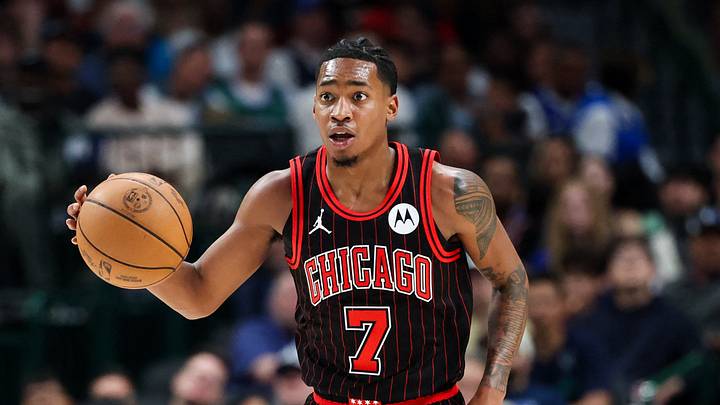
The Chicago Bulls' mission is clear heading into 2026-27. While they have veteran talent across the roster to help keep the team out of the bottom of the league's standings, they need to determine what they truly have in their young pieces.
Caleb Wilson and Dailyn Swain, Chicago's pair of first-round selections from this past Draft, will obviously garner the most attention this season. So will Matas Buzelis, who needs to take the leap into star territory in order to avoid restricted free agency with an extension next offseason.
But the Bulls also have a number of other decisions looming across their roster— including on young guard Rob Dillingham, who's entering the penultimate season of his rookie deal.
Chicago acquired Dillingham in the Ayo Dosunmu trade. Although we can harp on how they could've maximize the return for Dosunmu, Dillingham is still an on-ball guard with (hopefully) significant upside to be unlocked. If the Bulls were trying to compete this season, Dillingham certainly wouldn't be a primary fixture in their rotation. No matter what, Tre Jones will likely be the sixth man and the first guard off the bench.
But the Bulls need to give Dillingham his time in the spotlight nonetheless.
Rob Dillingham needs to get as many on-ball reps as possible in 2026-27
Dillingham certainly doesn't fit Bryson Graham's vision of defense and athleticism across the roster. He was an acquisition of the old regime, and that might quickly leave him as an odd man out in this rotation, especially when his rookie contract comes to an end.
But between now and then, the Bulls need to see what they have in the young guard.
As promising as Dillingham seemed when he was selected at eight overall in the 2024 NBA Draft, there were some clear pitfalls to his game that could stunt his development if they weren't addressed. He didn't profile necessarily as a high-volume playmaker, and his lack of length and defensive viability likely prohibited him from playing consistently on the wing. Those things haven't come together through his three NBA seasons.
Across 30 games with Chicago last season, Dillingham averaged 9.6 points, three rebounds, and 2.8 assists while shooting an even 30% from beyond the arc. Those numbers aren't good enough to crack a real NBA rotation.
As a pure roster decision, Jones should get the bulk of the minutes as the lead guard off the bench for Chicago. He averaged 14.1 points, 3.1 rebounds, and 5.4 assists in a starting role for Chicago last season. His perimeter shooting and defensive upside isn't much better than Dillingham's, but he's a more reliable scorer and a surer ball-handler at this point in his career.
If Dillingham has a future in the NBA, it's in a role similar to Jones'. The Bulls need to give Dillingham run with the bench unit whenever possible, especially alongside capable wing shooters like Isaac Okoro, to see if there's anything left to be unlocked there as a playmaker. As difficult as it will be to match Dillingham's diet of 21.5 minutes per game with this current roster, the coaching staff can't afford to cut him out of the rotation entirely.
Dillingham has two seasons left on his rookie deal— which means the urgency isn't necessarily on from a financial standpoint. But in terms of the future of this rebuild, Chicago desperately needs to determine who's worth developing and who's not. If Dillingham can prove himself as a playmaker this season, perhaps he's able to buy himself some extra time with the organization.
 Add us as a preferred source on Google