

The Chicago Bulls’ long-term plan can be summed up in one word: flexibility. Over the past few seasons, Chicago has avoided drastic moves, choosing instead to preserve its future. That approach has made the plan feel monotonous, because it is. The Bulls have largely remained idle, but that won’t last forever. It can’t.
Bulls’ roster shakeup looms
The Bulls’ roster features seven expiring contracts, making a shakeup all but inevitable. At least three to four of those players are unlikely to reprise their roles in the Windy City. The most likely candidates to return are Ayo Dosunmu, Coby White, and potentially one of Zach Collins or Kevin Huerter.
That means Chicago could have as many as seven, or more realistically, three to four roster spots up for grabs next season. A first-round draft pick will fill one, but the rest are completely volatile. Ultimately, it all hinges on the Bulls’ approach to free agency.
Yet, the top of the 2026 free-agent class isn’t particularly enticing, which could complicate the Bulls’ plans. Headlining the group are LeBron James, Kristaps Porzingis, Anfernee Simons, John Collins, Norman Powell, Quentin Grimes, and Cam Thomas. While several player and team options remain unresolved, the current landscape suggests free agency may offer limited upside for buyers.
However, we’ve yet to mention a caveat that could play into the Bulls’ favor: restricted free agency.
Betting on restricted free agency is a risky proposition. Restricted free agents are free to sign offer sheets with any NBA team, but their current team has the right to match and retain the player. While submitting an offer sheet doesn’t tie up cap space, the risk lies in coming away empty-handed, especially if multiple offers are matched, and alternative opportunities disappear.
Targeting Peyton Watson
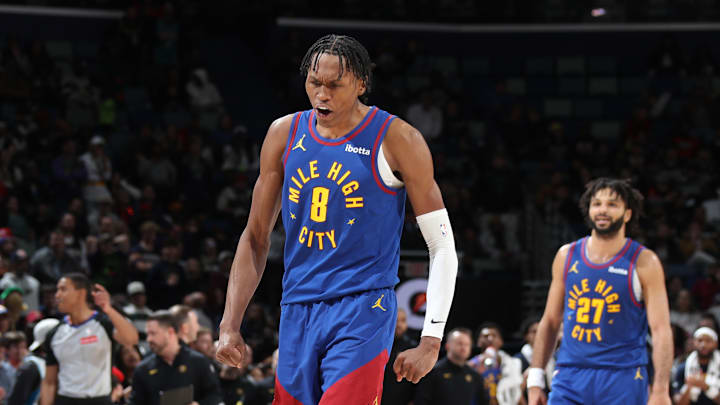
Still, it’s a risk worth taking if the right player is available, and one name should grab the Bulls’ attention: Peyton Watson. The 23-year-old wing is in the midst of a genuine breakout, averaging 14.0 points, 5.0 rebounds, and 1.8 assists per game, along with 1.0 steals and 1.0 blocks. He’s doing so efficiently, shooting 50.4 percent from the field and 40.3 percent from beyond the arc.
While those season-long numbers are eye-catching, what Watson has done in January is downright special. The UCLA product is averaging 21.9 points, 6.0 rebounds, 1.9 assists, 1.2 steals, and 1.3 blocks per game, while shooting near 50 percent from the floor and an impressive 44.6 percent from beyond the arc. Watson has been a revelation, and since Nikola Jokić went down with an injury, he’s arguably been the Denver Nuggets’ second-best player.
That brings us to the why. Why would Denver part ways with a 23-year-old emerging star? Simply put, they might have to. The Nuggets rank sixth in projected salary cap allocations next season, and their starting lineup alone is expected to cost $187 million—$21 million over the projected cap.
Denver has made it clear they’d like to re-sign Watson, but how much of that is just trade-deadline posturing? Will the Nuggets risk exceeding the dreaded second-apron to retain him after already committing $125 million to Christian Braun? That remains to be seen. Meanwhile, a team like the Bulls, with a clear path to freeing significant salary-cap space, could certainly play spoiler.
Chicago could theoretically throw a $25–30 million offer sheet at Watson, an amount Denver may be unwilling to match. While it’s a lot for a player with just half a season of breakout production, it could be the move that finally brings Chicago’s long-term plan to fruition.
 Add us as a preferred source on Google