

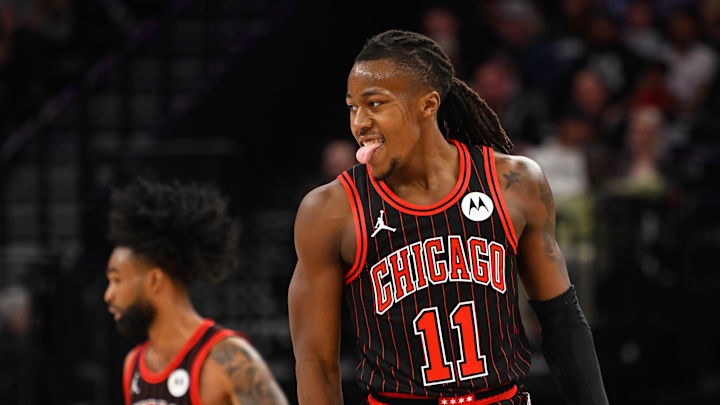
The Chicago Bulls fell to 17–20 on the season after a 108–93 loss to the Eastern Conference-leading, albeit shorthanded, Detroit Pistons. Detroit was without starters Cade Cunningham, Jalen Duren, and Tobias Harris, yet still received strong contributions from its reserves. Daniss Jenkins scored just two points but dished out 15 assists, while Isaiah Stewart dominated with 31 points on 14-of-17 shooting.
Chicago was without Josh Giddey and Coby White against Detroit, but still had three players score 20 or more. Matas Buzelis and Nikola Vučević finished with 20 apiece, while super-reserve Ayo Dosunmu led the team with 24 points on 10-of-15 shooting, including 4-of-6 from beyond the arc.
Dosunmu’s strong play offers Bulls a safety net
Outside of the three aforementioned Bulls, no other player reached double figures or shot better than 50.0 percent from the floor. It was a disappointing performance from much of the roster. Still, if there’s one takeaway from the 15-point loss, it’s that Chicago’s leading scorer, Ayo Dosunmu, remains a viable alternative should the Bulls decide to move on from Coby White ahead of the trade deadline.
Dosunmu has now scored in double figures in seven straight games and is averaging 18.0 points per game in January. While an 18.0-point-per-game month and a 14.0-point-per-game season pale in comparison to Coby White’s scoring output (19.2 points per game), Dosunmu’s efficiency and more well-rounded game make him a quality replacement.
The Chicago native is shooting 50.2 percent from the field, 43.0 percent from beyond the arc, and 86.1 percent from the free-throw line. And if Dosunmu’s usage rate (19.2) were closer to White’s (27.1), it’s reasonable to wonder whether his production could approach—or even surpass—those numbers.
White’s limited trade value elevates Dosunmu’s role
With White’s trade value seemingly taking a hit this season amid lingering calf issues from an offseason strain, inefficiency, and defensive shortcomings when he’s played (389th of 400 in CraftedNBA’s all-purpose defense metric), there’s reason to believe his return would be limited.
That perception was on display today when the Atlanta Hawks dealt four-time All-Star Trae Young to the Washington Wizards for CJ McCollum and Corey Kispert, a haul that offers little more than salary matching and veteran depth. Against that backdrop, it’s unlikely the Bulls would receive much more than salary-matching components and perhaps a draft pick or two for White.
But that raises a key question: why even trade White if his return would likely be meager? White is arguably the Bulls’ best player, and at just 25, he still has plenty of prime years ahead. Yet he’s on an expiring contract and poised for a significant raise after signing a three-year, $36 million deal in the 2023 offseason.
It’s a conundrum the Bulls have been wrestling with for some time. Still, the recent Trae Young trade and even the Cam Thomas restricted free agency saga could spark a new way of thinking. How much is a scoring guard of White’s caliber truly worth? Would the Bulls have to commit nearly $30 million per year? That remains to be seen, though it’s certainly the expectation from White’s camp.
If that’s the case, it might make sense for the Bulls to move on from White now, rather than risk losing him for nothing or committing to a hefty free-agent deal—even if the return is modest. Dosunmu’s stellar play further supports such a move. Even if Chicago receives only an aging veteran in return, they can feel confident in Dosunmu’s ability to step in and fill White’s former role.
 Add us as a preferred source on Google