

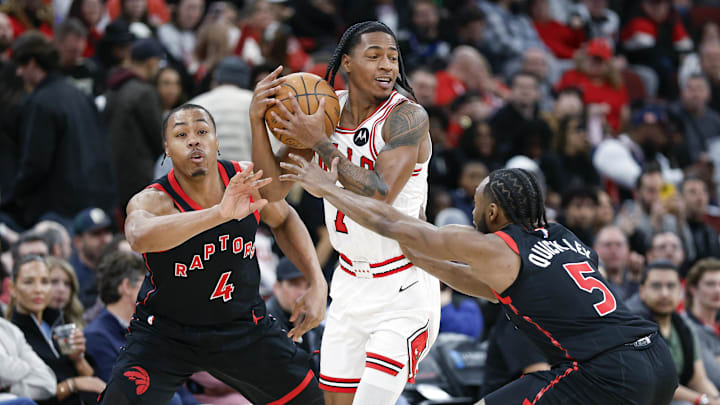
It’s well known by now, but the Chicago Bulls blowing up their roster at the trade deadline can’t be overstated. Chicago made a league-high seven trades, sending eight players out the door while bringing in seven new ones and nine second-round picks in a full-scale roster reset.
It truly was a trading frenzy. But what drew the most attention, and rightfully so, was the Bulls’ puzzling decision to acquire four guards. The roster was already guard-heavy entering the deadline, yet instead of moving out more than they brought in, they doubled down. Chicago parted with just three true guards, and one of whom (Jevon Carter) wasn’t even a part of the nightly rotation.
Carter has since gone on to average 7.3 points and 2.5 assists in nearly 20 minutes per game for the Orlando Magic. While Carter's production has come after Chicago’s deadline decisions, it reinforces a broader point: even guards outside the nightly rotation can still provide value in the right role. Despite already having a crowded backcourt, the Bulls still chose to add even more guards to the mix.
Since the trade deadline chaos, Billy Donovan has been tasked with the near-impossible job of finding minutes for Anfernee Simons, Collin Sexton, Jaden Ivey, and Rob Dillingham—all while still accommodating holdovers Josh Giddey and Tre Jones.
A trade deadline overhaul without direction
Thus far, the results have been inconsistent. In one particularly bizarre instance (with Donovan off the sideline), Ivey received a DNP-CD, which was easily the most head-scratching decision yet. Of Chicago’s seven deadline additions, only Ivey and Dillingham are under contract beyond this season. Ivey is a pending restricted free agent, but the Bulls retain the right to match any offer sheet or bring him back on his $13.4 million qualifying offer.
The logical conclusion, then, is that Ivey and Dillingham should be prioritized. Beyond their contractual control, they were also the two youngest players acquired at the deadline, which only strengthens the case for a development-first approach.
Yet that hasn’t been the case. As mentioned, Ivey was given a puzzling DNP-CD before being shut down for a minimum of two weeks with knee soreness. Dillingham, meanwhile, has logged the second-fewest minutes among the seven deadline additions, averaging just 19.3 per game. In a vacuum, limiting a still-developing second-year guard’s role might make sense for a contending team. But Chicago is anything but that. The Bulls have lost nine straight. Under those circumstances, Dillingham should be seeing meaningful floor time.
Too many guards, not enough minutes
However, if Dillingham and, eventually, Ivey are prioritized, whose minutes come at the expense? Sexton and Simons immediately come to mind, as does Jones, but it would be difficult to justify benching any of the three outright. Sexton injects much-needed energy into an otherwise flat team, Simons serves as the ideal three-point marksman alongside the pass-first Giddey, and Jones functions as the de facto floor general.
That’s the core problem. Chicago acquired legitimate talent, but the pieces overlap to the point of redundancy. Dillingham, Ivey, Sexton, and Simons all profile primarily as undersized scoring guards, offering limited positional versatility. It’s difficult to label any of the four as a true point guard (maybe Dillingham or Ivey?), and sliding them up to small forward to create additional minutes is hardly a viable solution.
Chicago understood the need to act, considering several key players approaching uncertain contract situations. The front office followed through. But in doing so, it created a roster heavy on redundant pieces rather than direction. Now, with limited time to evaluate overlapping skill sets, identifying true long-term building blocks becomes an increasingly complicated task.
 Add us as a preferred source on Google