

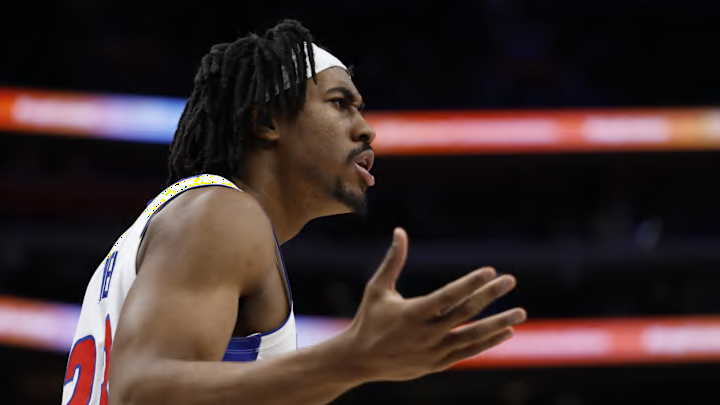
Coaching isn’t easy. Drawing up X’s and O’s is one thing. Managing in-game adjustments is another. But constructing a functional, fluid rotation? That might be the toughest task of all, especially after a chaotic trade deadline that saw the Chicago Bulls add seven players and move on from eight. Factor in an interim head coach, and growing pains were inevitable.
Yet in the Bulls’ first game back from the All-Star break—with Assistant Coach Wes Unseld Jr. leading the way—there was a baffling decision that's already left fans and pundits alike bewildered.
Jaden Ivey held out of rotation
Trade deadline acquisition Jaden Ivey, who had started three of Chicago’s previous four games, didn’t see the floor in the Bulls’ 110-101 loss to the Raptors.
Jaden Ivey is literally out of the rotation? What are we doing here?
— KENNY BEECHAM (@KOT4Q) February 20, 2026
Instead, another trade deadline acquisition, Anfernee Simons, led all Bulls guards with 31 minutes. Tre Jones, returning from injury, logged 22. Josh Giddey followed with 21, while Collin Sexton played 15, and Rob Dillingham just 10.
The decision apparently wasn’t reactionary. According to Bulls insider K.C. Johnson, the plan entering Thursday night was to give extended run to Giddey and Jones alongside the sharpshooting Simons. That plan played out… but the results were rough.
Regarding Jaden Ivey DNP-CD, acting head coach Wes Unseld Jr. said he communicated guard plan to team this AM and he wanted to see Tre Jones and Josh Giddey play extended minutes with Anfernee Simons.
— K.C. Johnson (@KCJHoop) February 20, 2026
In the nine-point loss, Giddey finished minus-22 and Simons minus-21. Jones was the only one of the trio in positive territory at plus-8.
Regardless of how Simons or anyone else performed, Ivey should be seeing the floor. That shouldn’t be up for negotiation. In the four games leading into the All-Star break, Ivey averaged 11.5 points, 4.8 rebounds, 4.0 assists, and 2.0 steals while shooting 41.7 percent from the field and 38.1 percent from three.
Ivey should be part of the Bulls’ lineup
But this isn’t just about recent production. It’s about future investment. Ivey is one of only two players the Bulls acquired at the deadline whose contracts extend beyond this season, along with Rob Dillingham. Technically, Ivey will enter restricted free agency this summer, but Chicago controls his rights. If he’s part of the long-term picture, he should be part of the present rotation.
Simons and Sexton are quality additions, but both are on expiring contracts. In many ways, they were acquired as merely salary-matching pieces. Yes, they combined for 31 points and six three-pointers. But short-term production shouldn't align with the Bulls’ long-term priorities.
Moreover, Patrick Williams logged 27 minutes against Toronto. There can also be an excuse made for Williams. He’s one of the few players on the roster standing 6-foot-7 or taller, and he’s the team's third-highest paid player, blah blah blah. Still, the results have not continually justified that workload. Chicago has been outscored by 14.2 points per 100 possessions with Williams on the floor this season, a mark that ranks in just the fourth percentile league-wide.
The Bulls already went 11 players deep, with each logging at least 10 minutes. Yet, at some point, the excuses run out. Ivey needs to be part of the evaluation process. Chicago traded for him for a reason. Leaving him glued to the bench doesn’t align with that vision.
 Add us as a preferred source on Google