

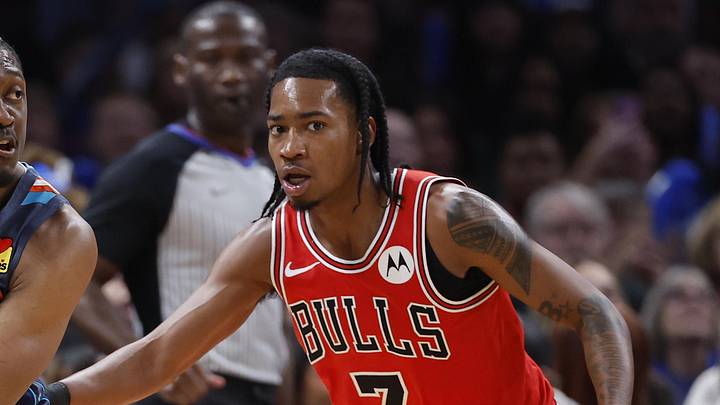
The Chicago Bulls were evidently content with what they accomplished in the first round of the 2026 NBA Draft.
After adding potential two-way star Caleb Wilson at fourth overall and athletic wing Dailyn Swain at 15th overall, the Bulls moved off of both of their selections in the second round of the 2026 NBA Draft. While their trade of the 56th overall pick to the Los Angeles Lakers merely yielded them cash considerations, their decision to ship off the 38th overall pick to the Indiana Pacers netted them second-year guard Kam Jones and a pair of second-round pick swaps, one in 2028 and one in 2030. Indiana ultimately selected Braden Smith out of Purdue with that selection.
In terms of immediate additions to the roster, Jones likely surpasses anything Chicago could've gotten at that point in the second round. Although he played a limited role on a rebuilding Pacers team last year, he's a slick ball-handler with strong passing chops and decent upside as an on-ball creator at the NBA level.
Looking at the Bulls' roster, he has a real chance to be the second guard off the bench behind Tre Jones in 2026-27. But this leaves polarizing young guard Rob Dillingham, whose team option for next season has already been picked up, in a bit of a precarious position.
Kam Jones could quickly siphon opportunities away from Rob Dillingham as the young guard faces free agency
It's easy to criticize the return the Bulls got for Ayo Dosunmnu, which included Dillingham, Leonard Miller, and a trio of second-round draft picks. Dosunmu just inked a five-year, $112 million extension with the Minnesota Timberwolves.
But that was under the old front office. Now, with Bryson Graham at the helm, it's time to figure out what can be done with the pieces left on this roster. That means that Dillingham's performance in 2026-27 could have major implications for his future in Chicago.
Although Dillingham came into the draft with many fans of his elite offensive upside, he's failed to put it together at the NBA level. He didn't truly crack the rotation during his first two seasons in Minnesota. Even with enhanced opportunity when he arrived with the Bulls, he still averaged just 9.6 points on 42.8% shooting from the field across 30 games. At 6'1", there are also still major concerns about Dillingham's ability to ever be a neutral defender.
Jones won't just be handed the keys to a bench role. But his offensive game is at least as polished as Dillingham's at this point in his career, and he'll have a real chance to beat out Dillingham in a competition for a larger rotational role.
Granted, Chicago's decision on Dillingham's 2027-28 club option will need to come before October 31, meaning that the Bulls won't have a full season of film on both guards before they decide on Dillingham's future.
The acquisition of Jones could make the decision to let Dillingham walk slightly easier. But even if that option is picked up, Jones has a real chance to leave Dillingham in the same position he was in with Minnesota— relegated to an end-of-bench role.
 Add us as a preferred source on Google