

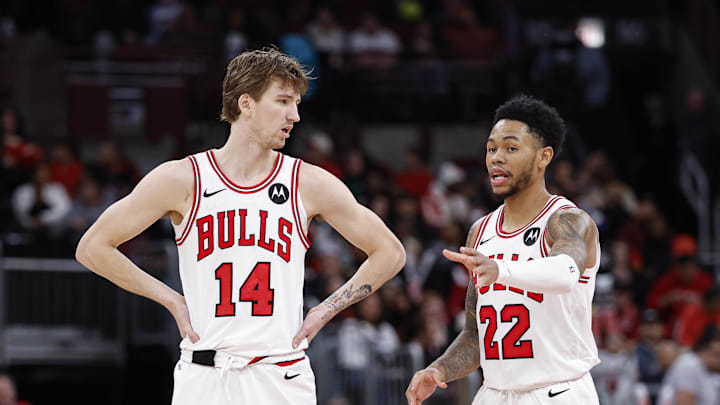
Hours ago, we wrote that despite losing 11 straight games, the Chicago Bulls’ draft positioning has barely improved. And it’s unlikely to get much better. The bottom six teams appear locked into those top draft slots. For example, Chicago still trails the sixth-place Utah Jazz by 5.5 games.
As a result, Chicago will most likely land between No. 7 and No. 9 on draft night, barring a stroke of lottery luck, which isn’t entirely out of the question. As it stands, the Bulls have a 20.3 percent chance of landing a top-four pick and a 4.5 percent chance of securing No. 1.
The Bulls’ second path to draft upside
Sure, a near-20 percent chance at a blue-chip prospect feels distant, and it is. Teams with long odds rarely jump the lottery to land their dream player. It did happen a season ago, when the Dallas Mavericks leapt 10 spots to select Cooper Flagg. Beyond that, though, moves of that magnitude have been few and far between over the past 15 years.
However, for the Bulls, there’s more than just lottery luck at play. Chicago owns the rights to the Portland Trail Blazers’ first-round pick, but it will only convey if the Blazers reach the postseason. And right now, Portland is on the brink, sitting in ninth place in the Western Conference.
Chicago’s 121-112 loss to Portland dropped the Bulls to 0-11 in February. The defeat came despite the Trail Blazers missing two of their top players, Deni Avdija and Shaedon Sharpe. With the win, Portland moved one game closer to the eighth-place, Steph Curry-less Golden State Warriors.
While retaining their first-round pick may be a priority, the Trail Blazers haven’t reached the postseason since 2021. And although they continue to field a relatively young roster, Portland also features established veterans such as Avdija, Jerami Grant, and Jrue Holiday. Making a playoff push with a balanced mix of veterans and young prospects wouldn’t be the worst outcome.
Yet, as noted earlier, if Portland does secure a postseason berth (say, as the eighth seed), it would likely draft 15th or 16th. And by the same logic, that slot wouldn’t be expected to yield a franchise difference-maker either.
Draft flexibility changes the equation
But as anyone would understand, two picks are better than one. If Chicago lands the No. 9 and No. 16 selections, for example, it would have the opportunity to add two young prospects in one draft, or package the picks together to potentially move up.
Both outcomes would benefit a team clearly lacking top-end talent. Chicago’s roster is unbalanced—heavy on guards, short on two-way players, and thin in the frontcourt. The draft represents the first step toward correcting past missteps, and it becomes even more impactful if Portland reaches the postseason and sends its first-round pick to Chicago.
 Add us as a preferred source on Google