

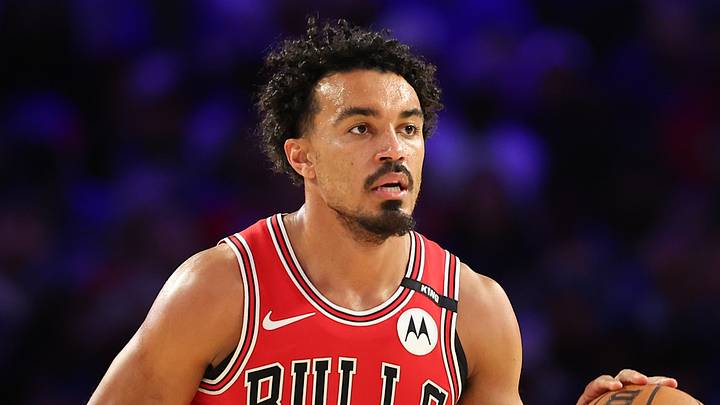
The Chicago Bulls need to be exploring every single trade option that may pop up for them this season.
This roster, outside of the addition of Caleb Wilson, simply isn't built according to the long-term vision that it seems both Bryson Graham and Tiago Splitter have for the organization. Graham's emphasis on defense and athleticism creates a clear archetype for Chicago moving forward, and Splitter's fast-break offense has revealed holes in the game of both Matas Buzelis and Josh Giddey that need to be accounted for, in some fashion, moving forward.
Almost no one on this roster, then, is fully safe as the Bulls approach Dec. 15, when players who signed contracts this past offseason are first eligible to be traded. And given how low the expectations are for this team over the remainder of the season, it wouldn't necessarily be a crime to strip this roster back of some of its expiring contracts between now and the deadline.
But there's still a needle to be threaded here. Wilson and Buzelis' development, as the two key pieces of this organization as it stands, needs to be prioritized—and completely stripping this roster of its playmaking and floor spacing isn't necessarily a viable option in that light.
Even if a player like Tre Jones is a real trade candidate at the deadline, then, the Bulls need to think twice before they pull the trigger on a deal. Unless a first-round pick is somehow on the table, Chicago may be better off hanging onto Jones into next season.
Tre Jones is still an important piece of the Bulls' offensive structure—especially if he makes a shift into the starting five
To this point in the season, there's been very little question about which of the Bulls' primary point guards has acclimated more quickly to Splitter's scheme. While Giddey has struggled heavily with his decrease in on-ball opportunities, he's averaged 10.4 points, 6.1 rebounds, and 9.4 assists while knocking down just 30.2% of his attempts from beyond the arc. He's still the versatile playmaker we're used to seeing on the court, but his ability to lead the offense up to Splitter's standard is certainly under question at this point.
Jones, meanwhile, has been highly effective in his bench minutes under Splitter—so much so that there have been calls to allow him to step into the starting lineup in Giddey's place. Across his first 14 games, he's averaged 11.1 points, 2.2 rebounds, and four assists while converting 48.9% of his attempts from the field. And he's done that while averaging eight fewer minutes than Giddey on a per-game basis.
Now, who knows whether Giddey will start to show signs of life in this offense in the coming weeks. His 23-point outing against the Denver Nuggets, a game which the Bulls ultimately dropped in OT, at least showed some promise.
But even so, moving off of Jones should be one of the last options the Bulls should consider this season.
Sure, his contract can technically be viewed as an expiring one given his team option worth $8 million for next season, and that could entice teams to make some serious inquiries to Chicago's front office when the time comes. Especially if there are teams that are in need of additional playmaking and bench scoring when the deadline rolls around, there could very well be some real offers on the table for Jones.
But after the fire sale that previous ownership undertook at last year's deadline, the Bulls are at a real deficit for guard play. The Dailyn Swain-to-point guard experiment hasn't paid dividends so far, and all of Buddy Hield, Jordan Hawkins, Norman Powell, and Jaylin Sellers are much better suited as shooters, not passers, at the shooting guard spot and on the wing.
And Buzelis and Wilson need to spend this season and next learning how to work alongside each other as play finishers and, to some extent, complementary playmakers. That's the strength of both of their games, and having viable guard play to facilitate that is a non-negotiable for Chicago. If moving off of Giddey's contract is at all a possibility Chicago wants to explore this season, then having Jones in the fold is an absolute necessity.
Jones is also under contract for another season at an exceedingly modest number, meaning there's no urgency for the Bulls to move him before they can diversify the playmaking options in their rotation.
Right now, Jones could likely fetch the Bulls something like a pair of second-round picks from a team in need of extra playmaking—like the Phoenix Suns or Denver Nuggeets. But unless a team is willing to put up a first-round pick to convince the Bulls to sacrifice the optionality of the final year of Jones' contract, it doesn't feel like a deal will ultimately be worth it in 2026-27.
 Add us as a preferred source on Google