

Under new lead executive Bryson Graham, the Chicago Bulls have finally found what fans have begged for almost since the end of the Michael Jordan era— a real, tangible direction.
Now, the path won't be easy. After the last regime got sub-par returns for their remaining tradeable assets, Graham received a huge break in the NBA Draft Lottery, jumping up to fourth overall and getting the opportunity to select Caleb Wilson. Along with the 6'9" power forward, Dailyn Swain, Rob Dillingham, Matas Buzels, and (to some extent) Josh Giddey will form the team's young core heading into their newly-minted rebuild.
Graham also granted the team ample flexibility with his moves this offseason, signing both Norman Powell and Zach Collins to two-year deals with team options that will make them relatively moveable at the trade deadline. The Bulls are in a better position, at least from a long-term perspective, than they've been in a while.
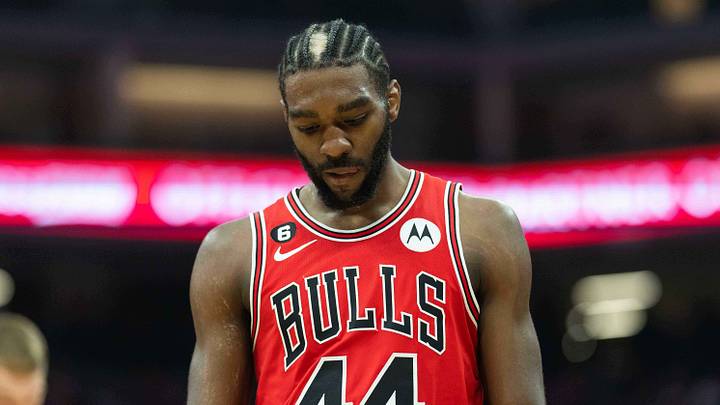
But the mistakes of the old regime will still pester Graham and these new-look Bulls. Patrick Williams' five-year, $90 million contract (with a player option to boot) was named as the NBA's eighth-worst contract by Sam Quinn at CBS Sports. While continuing to develop and build out the young core should be the organization's first priority, sorting out what to do with Williams' deal should be right up there near the top of the to-do list.
The Bulls may have to wait out the Patrick Williams contract, but they need to explore every option in the meantime
Although Williams' $18 million annual value isn't as disastrous as some of the max deals given out around the league, his utter lack of viable NBA production certainly stings. He averaged just seven points, three rebounds, and 1.5 assists while shooting 37.2% from the field across 72 games last season. It was a low point even for a player who, as Quinn points out, would likely be playing slightly above the minimum for any other team.
"The Bulls paid Patrick Williams $90 million because they drafted him No. 4 overall. That's it. He has very impressive physical tools that have never manifested into consistent, winning basketball. He's a minimum-level player at this point who'd probably get slightly more than that on the open market for upside alone, but he's making more than the mid-level exception." Sam Quinn, CBS Sports
As long as the Bulls are rebuilding and aren't looking to give out max deals, Williams' contract won't be a major issue. But Buzelis will be eligible for an extension next offseason, and he can certainly put himself into that territory with a major leap in 2026-27.
If Chicago ultimately needs to rid itself of the albatross that is Williams' contract, what options do they have?
Not very many.
They could hand out draft capital to entice a cap-space team to take on his contract next offseason. But the Bulls don't possess any first-round selections outside of their own between now and 2033. Graham's goal should be to amass draft capital, not dish it out.
They could also attempt to get involved in a larger trade, attaching Williams' $18 million salary for matching purposes when another team inevitably attempts to acquire a star. But Williams has a player option in 2028-29 that could make his deal a difficult pill to swallow for whatever team ends up on the receiving end.
There's also the waive-and-stretch approach, which the Milwaukee Bucks infamously took with Damian Lillard. That would spread the $36 million currently guaranteed to Williams out over a longer period— likely somewhere in the range of five seasons.
Perhaps Williams plays his way into having some trade value under Tiago Splitter. That would be the ideal scenario, at least, if not the realistic one.
But if Graham's mission is to move forward with the organization and leave the previous era behind them, there needs to be a path to move off of Williams eventually— assuming it's at all possible.
 Add us as a preferred source on Google