

Based on the head coach candidates that have earned interviews with Bulls' executive vice president of basketball operations, Bryson Graham, it’s evident that defense will be prioritized in Graham’s first Bulls roster build.
Discussing NBA defense is always an intriguing experience because of the nature of basketball, which generally tilts the perceived game impacts towards the offensive side of the game: scoring, free-throw attempts, and passing, to offer a few examples.
Yes, there are defensive components to a basketball box score in steals and blocks, however that does not tell the whole story of a basketball defensive possession.
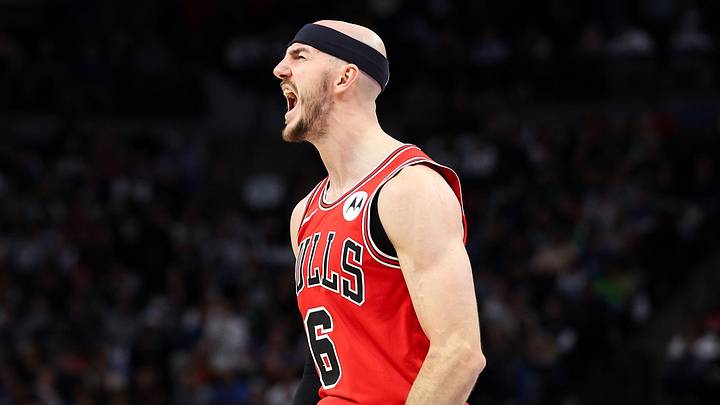
The closest thing to a consistent, competent team defense the Bulls have put on the floor over the last six seasons is the singular impact of former Bulls guard Alex Caruso.
Caruso explained his defensive philosophy to Los Angeles Lakers head coach JJ Redick, when he was merely a podcast host, on Redick’s The Old Man and The Three podcast.
The Caruso code for NBA defense - physical attributes, mobility, effort, and game intuition - represents a good complementary philosophy to frame the defense Graham should build to help realize his S.L.A.P. principles in Chicago.
Defining the optimal blueprint for a revitalized Bulls defense
How Bryson Graham goes about acquiring the players to build his defense is less of a concern because, frankly, every player Graham acquires leading up to the Bulls' 2026 NBA training camp should be judged with heavy emphasis on what they add to or subtract from NBA team defense.
Draft, free agency, trades, it does not matter; the player acquisition method used to fill out the Bulls roster this summer does not matter.
What does matter is that Bryson Graham is prioritizing maximum positional size up and down his roster in terms of height, weight, and wingspan. Going into the 2026 NBA offseason, the Bulls have 10 players under contract, and compared to the 2025-26 NBA season average player height and weight measurements according to The Ringer's Kirk Goldsberry, only Josh Giddey and Leonard Miller possess above-average positional size.
Lateral movement is an open question mark on the Bulls roster and known liability for both Josh Giddey and Patrick Williams, whose mobility was flagged as a development concern in Williams' pre-draft scouting. Both players represent defensive weak links anytime the Bulls’ defense is put into rotation, and long-term, Graham should have a plan to improve or remove these liabilities from his roster.
T.J. McConnell is unstoppable from the midrange 😈 pic.twitter.com/wXJq57uXP6
— Indiana Pacers (@Pacers) March 2, 2025
Effort and instincts are also ample opportunities for roster improvement relative to Williams, who best represents the player archetype the previous Bulls front office regime, helmed by Arturas Karnisovas, coveted in Williams, Dalen Terry, and Julian Phillips.
Where Williams occasionally displays flashes of defensive instincts, he is also capable of flagrant examples of disengaged or misdirected game effort. Where Dalen Terry or Julian Phillips did contribute energy or motor in their Bulls minutes, their ability to develop reliable game instincts that can be trusted when it’s time to win games never materialized under former Bulls head coach Billy Donovan’s watch.
Overall, Bryson Graham’s defensive roster build agenda should be clear: improve positional size, turn over the roster towards players with elite mobility, and bring players into his locker room that will make high motor and basketball IQ the new identity of the Chicago Bulls.
 Add us as a preferred source on Google