

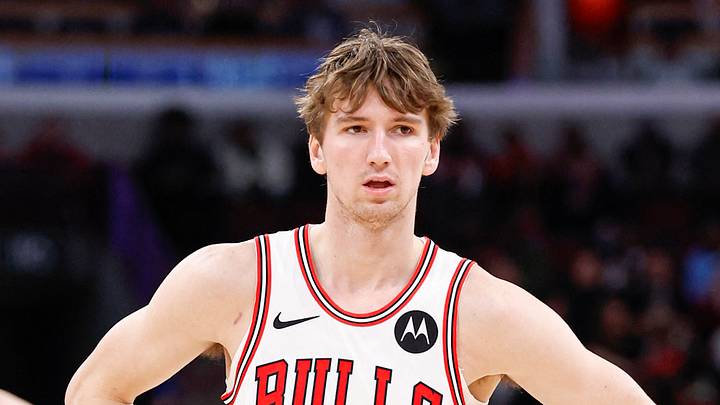
Matas Buzelis is rightly perceived as a core figure in the 2026-27 Chicago Bulls roster. Buzelis is also entering the all-too-crucial third season of an NBA rookie-scale contract that often weighs heavily on contract extension negotiations or the absence of such negotiations.
As much as Bulls lead front office executive Bryson Graham has extolled the virtue of front office flexibility throughout the 2026 NBA offseason, coupled with declaring a relatively unpretentious 2026-27 NBA goal of seeking organizational clarity, no Bulls player, with perhaps the exception of Caleb Wilson, should feel 100% immune from trade consideration by the Bulls.
To be clear, trading Matas Buzelis shouldn’t be a priority for the Bulls during the 2026-27 NBA season, while at the same time it shouldn’t be a scenario where the Bulls’ front office avoids doing their homework to arrive at a sticker price to entertain Buzelis trade talks.
Again, the Bulls don’t need to trade Buzelis, and frankly, there are Bulls players who absolutely should be on the trade block before a Buzelis trade ever enters a Bryson Graham conference call with another NBA team.
The prerequisites for the Bulls trading Buzelis should simply amount to three conditions being realized rapidly over the next two NBA seasons: Caleb Wilson becomes an All-NBA player, Matas Buzelis’ progression as an NBA player doesn’t keep pace with Wilson’s, and the Bulls should have surplus draft picks in their draft capital portfolio before entertaining this sort of trade.
With clear prerequisites established, now a Buzelis trade price tag should be discussed.
Matas Buzelis trade MSRP: Evan Mobley
If a scenario eventually presents itself to Graham where he no longer sees Buzelis as a core component of his Bulls roster or culture, his first target to receive in return for Buzelis should be Cleveland Cavaliers forward Evan Mobley.
What would it likely take for the Cavaliers to seriously consider trading Mobley? Imagine a scenario similar to when the Minnesota Timberwolves chose to send Karl-Anthony Towns to the Knicks to avoid the financial repercussions of Towns’ four-year, $220 million designated veteran extension that kicked in at the start of the 2024-25 NBA season, coupled with hitting a playoff ceiling of the NBA Western Conference Finals in the 2024 NBA playoffs.
The Cavaliers finally exercised a playoff demon in the 2026 NBA playoffs by returning to the NBA Eastern Conference Finals for the first time since 2018. Yet, the Cavaliers were effectively dead on arrival, as the eventual 2025-26 NBA champion New York Knicks swept the Cavaliers in the conference finals round of the 2026 NBA Playoffs.
Financial constraints are also a reality for the Cavaliers as a team that has already suffered a second apron penalty of a frozen draft pick (2033 Cavalier first-round pick) and is $12.8 million away from the second apron, according to Spotrac.
Acquiring Buzelis would imply the Cavaliers remain committed to a Donovan Mitchell-led backcourt while perhaps seeking a frontcourt player with a more consistent offensive presence than Mobley.
On the Bulls' front, trading Buzelis would be reasonable if Caleb Wilson fully realizes his hype-driven potential to the extent that Buzelis becomes a redundant, instead of complementary, player relative to Wilson.
Evan Mobley, barring catastrophic injury, should be a formidable defensive player throughout his career, and that sort of player profile in the long run may serve Caleb Wilson better if he ascends to become an undisputed All-NBA creator.
A dose of reality to tie this thought exercise all together: this sort of trade would likely require the Bulls to surrender draft capital, as the New York Knicks surrendered a surplus first-round draft pick to acquire Towns in 2024.
Surplus draft capital stashed in the Bulls' draft pick coffers is imperative for the Bulls to ever position themselves to play in a trade scenario like this to ensure the deal also does not mortgage the Bulls’ draft future.
 Add us as a preferred source on Google