

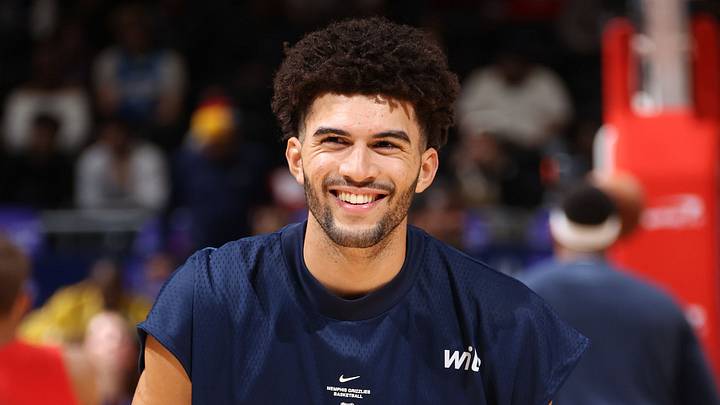
Cameron Boozer and Caleb Wilson will likely spend their entire NBA careers being compared to one another. The promising power forwards went head-to-head in college in the legendary Duke vs. North Carolina rivalry and then went No. 3 and No. 4 respectively in the 2026 NBA Draft. Though it's early, the Memphis Grizzlies are giving Boozer an early edge the Chicago Bulls are struggling to match.
The good news for Wilson and the Bulls, however, is that the formula Memphis has committed to following is one that can be replicated: Wing depth, defensive-minded players, high-quality rim protectors, and playmakers who can shoot.
Clearly, Boozer and Wilson play different styles, have different physical profiles, and rely on different skill sets. As such, a one-for-one comparison would be irrational. In saying that, their differences don't change the fact that Memphis has built a replicable formula for success.
By prioritizing wing depth, loading the interior with talented bigs who prioritize defense, and embracing the need for playmakers who can shoot, Memphis has given Boozer the tools to succeed.
While Chicago is 4-10, Memphis is 12-4 and just 1.0 game back of the No. 1 seed in the Western Conference. The Grizzlies have reached that point by ranking No. 1 in the NBA in offensive rating and No. 9 in defensive rating. More importantly, they've made Boozer their hub—but not their only source of success on either end of the floor.
As the Bulls search for ways to ideally complement Wilson, they must channel some of what's worked for Boozer and build out their roster accordingly.
Grizzlies have prioritized wing depth, defense, and sharpshooters
Along the wings, Memphis has no shortage of options for any given game or moment. Cedric Coward and Jaylen Wells have been the consistent starters, offering athleticism, shooting, and defense as skills that help fuel the Grizzlies' success.
When either one comes off the court, Memphis can turn to a number of productive and respectable players including Jerami Grant and Taylor Hendricks. Though now injured, GG Jackson was also on that list.
The supporting players may not be traditional wings, but the Grizzlies have adapted to their strengths and weaknesses. Whether they're at the 3 or the 4, they function in lineups that allow their better elements to shine through—all the while continuing to complement or act in relief of Boozer.
Memphis has also run out a backcourt led by Ty Jerome and Cam Spencer, who are sharpshooting guards capable of playing the 1 or 2, and running the offense as playmakers.
At the center position, Zach Edey, Quinten Post, and Isaiah Stewart have led one of the NBA's most stifling rim protection groups. Memphis is currently No. 3 in the NBA in opponent field goal percentage at the rim—far ahead of Chicago, which ranks No. 16.
The Bulls have reason for optimism with Nic Claxton inching closer to playing without a minutes restriction, but work still needs to be done in every one of these areas.
Cameron Boozer has the help Caleb Wilson currently lacks
That starts with the fact that Memphis is No. 1 in the NBA in three-point field goal percentage and Chicago is No. 28. The Bulls simply aren't making the most of their opportunities to bury jumpers, with primary playmakers Josh Giddey and Tre Jones shooting 31.5 and 29.4 percent from beyond the arc.
It's not exclusively on the point guards to shoot efficiently, but when the players who run the offense can't effectively play without the ball, hurdles are inevitably presented to their teammates.
The wings aren't necessarily a weakness for Chicago, but the depth beyond high-quality starters Matas Buzelis and Norman Powell is lackluster. Noa Essengue has potential and Jaylin Sellers is showing out in the G League, but the Bulls need something more tangible to meet the modern standard.
Building out the perimeter with defensive-minded wings who can help space the floor should thus be a top priority for the Bulls moving forward.
Along the interior, Claxton and Jalen Smith are playing well individually, but questions persist about their long-term fit. Claxton appears to be a trade piece, but even if he isn't, he's arguably too thin to defend stronger players in the post and Smith lacks ideal size for the 5. Finding a long-term answer should thus be a focal point.
Chicago clearly needs different strengths specific to Wilson's skill set than Memphis needs in order to help Boozer, but the general structure of the Grizzlies' roster should be a model the Bulls follow.
 Add us as a preferred source on Google