

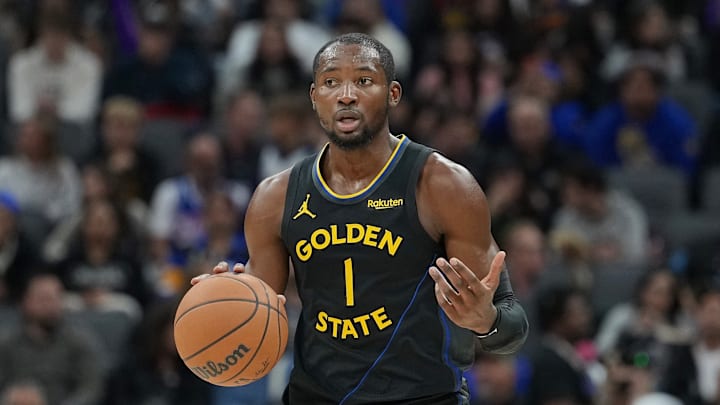
If there’s one near-inevitability ahead of the NBA trade deadline, it’s that the Golden State Warriors are poised to trade disgruntled forward Jonathan Kuminga. Nothing in the NBA comes with 100 percent certainty, but Kuminga’s exodus from the Bay Area in the coming weeks feels about as close as it gets.
Kuminga’s relationship with the Warriors appears beyond repair. Between inconsistent playing time, unexplained benchings, and a contentious contract negotiation, things haven’t exactly been peachy for the 23-year-old wing in Golden State.
Despite strong counting stats and a desirable player profile, Kuminga just hasn’t found a consistent fit in Steve Kerr’s rotations. There’s more beneath the surface—he’s an inconsistent shooter, can stall an offense, and doesn’t always defend to the level his athletic frame suggests—but that hasn’t stopped teams from viewing the soon-to-be fifth-year wing as a worthwhile trade target.
Bulls buy-low on Jonathan Kuminga
The Chicago Bulls have had interest in Kuminga for quite some time, dating back to the 2024 trade deadline, when the Warriors were hellbent on acquiring Alex Caruso before Chicago ultimately passed. That interest lingered into the 2025 offseason—and even appeared to peak—after Kuminga’s camp reportedly listed the Windy City as his preferred destination. But amid Kuminga’s contract negotiations with Golden State, the Bulls pivoted, trading for Isaac Okoro and effectively moving on.
Kuminga ultimately re-signed with Golden State just days before the start of training camp. However, the deal was structured with flexibility in mind. The 6-foot-7 forward signed a two-year, $46.8 million contract with a team option in the second season, a framework that made him trade-eligible as of January 15 and left the door open for a potential fresh start in 2026–27.
Fast forward to mid-January, and the contract’s built-in flexibility became consequential. The 23-year-old requested a trade the day he became eligible to be moved. While seeking a fresh start may benefit Kuminga, the public nature of the request significantly undercut Golden State’s leverage. His value has declined over the past year, opening the door for rival teams to attempt to acquire him at a discount.
Considering Chicago’s prolonged interest, Kuminga’s trade request, and Golden State’s diminished leverage, a straightforward swap that lands the forward in the Windy City makes sense. In this scenario, the Bulls would send Nikola Vucevic and a 2028 second-round pick to the Warriors in exchange for Kuminga.
Breaking down the trade for each team
Much like Chicago’s long-standing interest in Kuminga, the Warriors have been linked to Vucevic for some time. Dating back to last December, Golden State has been connected to the former All-Star, though a deal never materialized. At the time, talks stalled due to the Bulls’ insistence on receiving a first-round pick in return.
This time around, with the Bulls yet to move the 35-year-old impending free agent, Chicago would have far more incentive to deal Vooch in a package for Kuminga. A straight player-for-player swap isn’t the most appeasing—particularly given the 12-year age gap between the two—which is why a future second-round pick is included to help bridge the value gap.
While this may not represent an ideal return for Golden State, the Warriors’ options are limited given Kuminga’s prolonged benching and trade request. Vucevic offers immediate on-court value while preserving long-term financial flexibility.
Assuming the Warriors make this trade, does it make sense for the Bulls?
Grade the Trade: Do the Bulls make this deal?
This trade makes sense for Chicago. While Kuminga may not slot seamlessly into the roster, talent should take precedence for a team in the midst of a (halfhearted) rebuild. The Bulls sit 20-22, ninth in the Eastern Conference, and looking at the top of the standings, there are few teams they can realistically compete with at this stage.
Parting with Vucevic leaves just Jalen Smith and the injured Zach Collins as Chicago’s primary bigs. Smith has exceeded expectations, lessening the immediate impact of moving Vucevic. Collins has performed well since joining the Bulls before last year’s trade deadline, though injury concerns remain for the 28-year-old center.
There is still a two-way signee, Lachlan Olbrich, who has excelled in the G-League but struggled in the NBA. Even so, with or without Vucevic, talent should take priority over roster cohesion at this stage of the rebuild.
In this trade, Chicago finally moves on from Vucevic, who likely won’t be back next season, and adds Kuminga, a player with the potential to be a long-term starting wing. A Matas Buzelis–Kuminga duo would rank among the most promising young wing tandems in the league. The future second-round pick going to Golden State is just the cherry on top of this hypothetical deal.
Grade: B+
 Add us as a preferred source on Google