

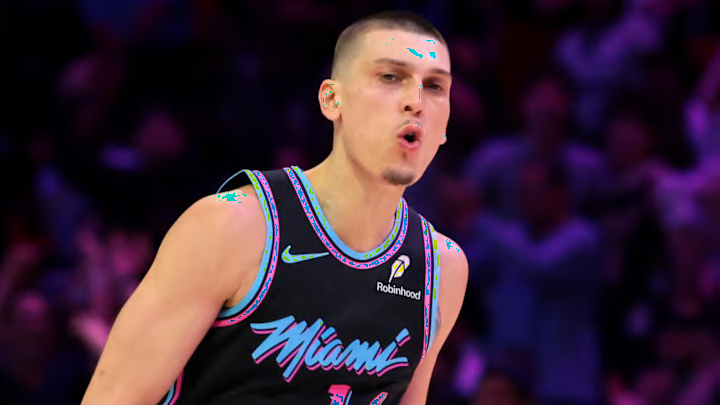
There is something inherently hip-hop about the contemporary NBA front office management concept of seeking trade returns of a perceived bad contract, plus draft capital.
The pioneering rap group Run-DMC canonized this point in the lyrics of their legendary 1986 song Peter Piper, “Not bad meaning bad, but bad meaning good”. The underlying principle to take away from the lyric is flipping the perception of a liability into an advantage.
A bad NBA contract, because of dollar value or player performance, is inherently bad. However, attach X amount of draft compensation to the bad contract, and suddenly you’ve packaged a good asset that most rebuilding NBA teams should be eager to acquire.
The Chicago Bulls, with their rebooted front office helmed by EVP of basketball operations Bryson Graham, are an NBA franchise that has accepted the fate of an organization in the infancy of a rebuild.
NBA salary cap context
The Bulls are in a favorable NBA salary cap position through the lens of a few NBA salary cap data points, per Spotrac:
- Active salary: $95,366,560.00
- Maximum salary cap: $$165,000,000.00
- Luxury tax threshold: $201,000,000.00
Also worth noting, the 2023 NBA-NBPA collective bargaining agreement mandates that all franchises must spend a minimum of 90% of their salary cap by the first day of each regular season to avoid non-compliance penalties. This means, at a minimum, the Bulls need to increase their active roster salary to $148,500,000.00 by the first day of the 2026-27 NBA regular season.
This all means the Bulls have a grand opportunity to take in a big, bad contract in the 2026 offseason to grow their draft assets. Let's take, for example, Miami Heat guard Tyler Herro. Herro will enter the final season of his Miami Heat contract when the 2026-27 NBA regular season tips off.
Herro is due to earn $33M in the expiring season of his contract, and he is also the 2021-22 NBA Sixth Man of the Year, in addition to a one-time NBA All-Star. Why should the Bulls target Herro as a player + draft picks trade acquisition?
Qualifications for a good bad NBA contract
The key strategy the Bulls should exercise when acquiring a bad contract player isn’t just to grab any random overpaid NBA player. Rather, find an NBA player with a big contract who enters the Bulls roster with draft capital attached, and also has the likelihood of rehabbing their trade value to exit the Bulls roster and return additional draft capital to the Bulls.
Consider the following a simple qualifications list to judge if a large contract NBA player belongs on a rebuilding Bulls roster:
- Two years or less left on the current contract
- Past league recognition or awards
- Ideally, age 30 or younger
 Add us as a preferred source on Google