

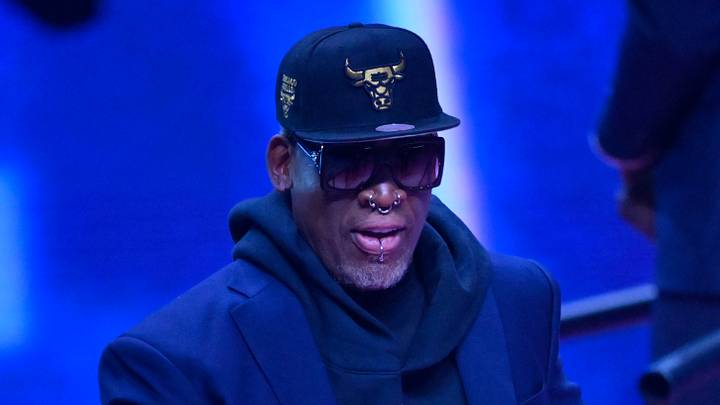
For seven NBA seasons, he was a foe fiercely hated by Chicago Bulls fans. A two-year detour in San Antonio gave him the appearance of something between damaged goods or a complete wild card.
By 1995, then-Bulls general manager Jerry Krause pushed his chips into the middle of his roster-building poker table near the dawn of the 1995-96 NBA season by executing an all-time franchise-defining trade, acquiring forward Dennis Rodman in exchange for center Will Perdue on Oct 2, 1995.
Of course, the rest is dynastic history, yet the manner in which Rodman wrote his chapters of Chicago Bulls history, dominating the entire concept of basketball rebounds, was amazing to watch in the moment. 30-plus years removed from Rodman’s arrival in Chicago, his rebounding impact is still a sight to behold.
Contextualizing Dennis Rodman’s rebounding
It’s not that prior to Dennis Rodman ushering in the Bulls’ second three-peat, from 1995 to 1998, the Bulls had a rebounding problem. Quite the contrary, with emphasis on offensive rebounding, the Bulls ranked in the NBA top-10 in offensive rebounds per game during the 1992-93 and 1994-95 NBA regular seasons.
The addition of Dennis Rodman to the Bulls ensured the Chicago Bulls would be undisputed league leaders in rebounding across the board (pun intended), defensive and offensive rebounding, as long as Rodman suited up in a Bulls uniform. In each of Rodman's three NBA seasons, the Bulls finished NBA-ranked top-5 in total rebounds, according to Basketball Reference.
Rodman’s rebounding impact was profound for the whole Bulls roster, initiating countless fast-break opportunities that led to easy offense for role players, and was symbiotic with the Bulls' two principal standard-setting superstars of the 1990s dynasty era, forward Scottie Pippen and guard Michael Jordan.
It should come as no surprise that Rodman’s best assist performance of his 14-year NBA career came from his time with the Chicago Bulls, executing crisp passes off a cleared offensive rebound to Pippen and Jordan or flexing his basketball IQ to make precision passing reads in the dynasty Bulls’ famed triangle offense. Rodman averaged 4.3 assists per 100 possessions in his three seasons with the Chicago Bulls, according to Basketball Reference.
Rodman’s Bulls impact may never be duplicated in Chicago
Dennis Rodman’s hyper-focus on rebounding made him an S-tier glue guy for the Bulls' fourth, fifth, and sixth NBA championship rosters. Rodman was the league leader in total (offensive and defensive) rebounds in all three of his NBA seasons with the Bulls.
At the same time, Rodman rarely ever asserted himself in any scoring facet of the game as a single-digit player in points per game, field goal attempts per game, and free-throw attempts per game, according to Basketball Reference.
It’s hard to imagine that another NBA player, let alone another Bulls player, will ever display such an outsized positive impact on basketball games while also being one of the most specialized NBA basketball players of all time.
 Add us as a preferred source on Google