

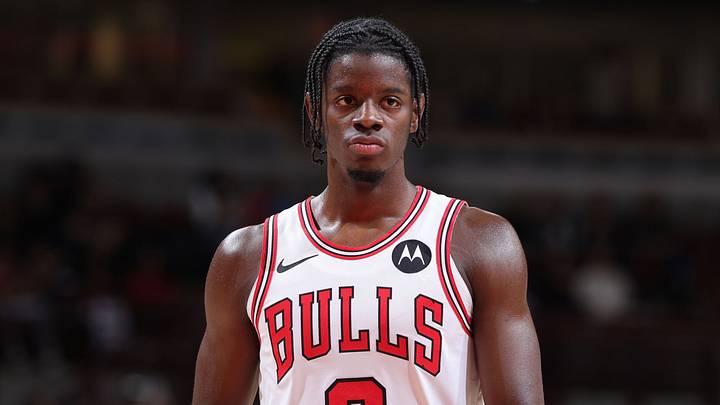
The Caleb Wilson era has officially begun! The Chicago Bulls played their first regular season game since drafting Wilson at No. 4 overall and saw flashes of his potential along the way in a 135-92 blowout loss to the Toronto Raptors.
Though it may not have been an ideal result or a flawless performance, there were clear signs of intrigue as Wilson posted 16 points, four rebounds, three steals, and a block on 7-of-21 shooting from the field and a 1-of-8 mark from beyond the arc.
To contextualize how impressive the highs were and how concerning the lows may be, a simple question beckons: How does his NBA debut compare to that of the Bulls legends who came before him?
For context: The only players to whom Wilson will be compared in this article are those who made their professional debuts with the Bulls. Artis Gilmore, for instance, will not be on the list due to the fact that Chicago drafted him, but he then played five seasons in the ABA before joining the Bulls.
Additionally, some players will inevitably be snubbed as the list is trimmed to five. For instance: Jimmy Butler averaged just 2.6 minutes per game as a rookie and simply isn't an ideal player to compare Wilson's debut to. In saying that, the only four players in Bulls history to make All-NBA First Team will make the cut.
In evaluating their first games, it should become clear that Wilson having flaws in his first career NBA game isn't all that alarming.
Michael Jordan: 109-93 win on Oct. 26, 1984 vs. Washington Bullets
Believe it or not: Even Michael Jordan is proof that a player's first NBA game can be tough sledding. Jordan finished with admittedly absurd numbers of 16 points, seven assists, six rebounds, four blocks, and two steals in 40 minutes. Clearly, not everyone has the same definition of "tough sledding."
In saying that, Jordan also shot 5-of-16 from the field and committed five turnovers. He finished fourth on the Bulls in scoring that night behind Orlando Woolridge with 28 points, Quintin Dailey with 25, and Steve Johnson with 18.
Suffice it to say, six championships, five regular season MVP awards, and a record 10 scoring titles later, Jordan figured out how to thrive in the NBA. He also became one of the most efficient scorers in the history of basketball.
Jordan's inefficient NBA debut acts as a crucial reminder, however, that a player's first game is an uphill battle and that fans shouldn't lose their cool if it's not all positive.
Scottie Pippen: 104-94 win on Nov. 7, 1987 vs. Philadelphia 76ers
Scottie Pippen started his career the same way he played his career: By doing a little bit of everything. The do-it-all forward played 23 minutes in his first NBA game, recording 10 points, four assists, one rebound, and two steals on 4-of-7 shooting from the field.
Pippen was one of six Bulls who scored in double figures that night, with Jordan leading the charge with 36 points, five rebounds, three assists, six steals, and four blocks. Pippen was also third in assists that night behind John Paxson with seven and Sedale Threatt with five.
Pippen would go on to become one of the most well-rounded players in NBA history, as well as a peak example of the point forward role. Between his first and last All-Star or All-NBA seasons—1989-90 and 1997-98—he averaged 19.6 points, 7.2 rebounds, 5.9 assists, 2.3 steals, and 1.0 block per game.
It all started with a fairly low-volume performance, however, which offers invaluable insight into how it's not necessary for first-year players to instantly excel in big roles in order to ultimately secure one.
Luol Deng: 111-106 loss on Nov. 5, 2004 vs. New Jersey Nets
Narrowing the list to five players required a debate between Luol Deng, Horace Grant, and Reggie Theus. The decision was ultimately made to go with Deng for two simple reasons: Length of tenure and the role they played. While Grant spent seven years in Chicago and Theus was a high-volume scorer, Deng combined those two strengths with a 10-year tenure and a prominent scoring role.
Simply put: Comparing Wilson to the Bulls who paved the way for him requires an at least somewhat comparable role if a feat like All-NBA isn't factored in—as it will be with the next inclusion.
All of that established, Deng's 10-year run with the Bulls began with him posting a double-double. He tallied 18 points and 10 rebounds, as well as three assists, one block, and six offensive boards, while shooting 8-of-21 from the field and 1-of-5 from beyond the arc.
It was the start of an excellent run that saw Deng help the Bulls make six playoff appearances and a trip to the 2011 Conference Finals. During that time, he averaged 16.1 points per game and secured two All-Star Game selections and one All-Defensive Team nod.
If Wilson can become the type of reliable and productive two-way forward that Deng was, Chicago should be happy to have a winning player as a part of their core.
Joakim Noah: 97-91 loss on Nov. 6, 2007 vs. LA Clippers
Joakim Noah actually sat for the first three games of his rookie season, but made his debut during the Bulls' fourth outing in 2007-08. During that game, he shot 0-of-4 from the field, yet still managed to flash the potential that would make him one of Chicago's most decorated players ever.
Noah finished his debut with two points, four rebounds, two offensive boards, three blocks, and one steal in 19 minutes of play. He brought his signature brand of all-out intensity on the defensive end of the floor and offered insight into what his future would hold.
Noah, of course, would go on to help the Bulls reach the 2011 Eastern Conference Finals. He also won the 2013-14 Defensive Player of the Year award, made two All-Star Game appearances, secured an All-NBA First Team nod, and even had a season during which he finished fourth in MVP voting.
Moreover, Noah became one of the best passing big men in the NBA fairly late in his career. If nothing else, Noah is proof that evolution is not always linear.
Derrick Rose: 108-95 win on Oct. 28, 2008 vs. Milwaukee Bucks
Chicago's own Derrick Rose made his triumphant Bulls debut 18 years ago and quickly showed how dynamic he could become. He helped his hometown team overcome a division rival, with a 108-95 win over the Milwaukee Bucks.
Rose finished the game with 11 points, nine assists, four rebounds, and three steals in 32 minutes. He shot just 3-of-9 from the field, but made a positive impact in multiple phases of the game. That includes the fact that he led all players in assists and steals that night, and was one of six Bulls who scored in double figures.
Rose would ultimately become one of the most unstoppable scoring forces in the NBA. During his MVP season in 2010-11, he averaged 25.0 points and 7.7 assists per game on a defensive-minded Bulls team that disproportionately relied on him for offensive success.
Much like Jordan, however, Rose began his Bulls career by shooting inefficiently and finding other ways to contribute. Once again, essential context to consider when evaluating Wilson's first regular season performance with Chicago.
All in all, what Bulls history reveals is that Wilson is in a great position to turn in a memorable rookie season and overall career considering how the future dictates far more than an opener.
 Add us as a preferred source on Google