

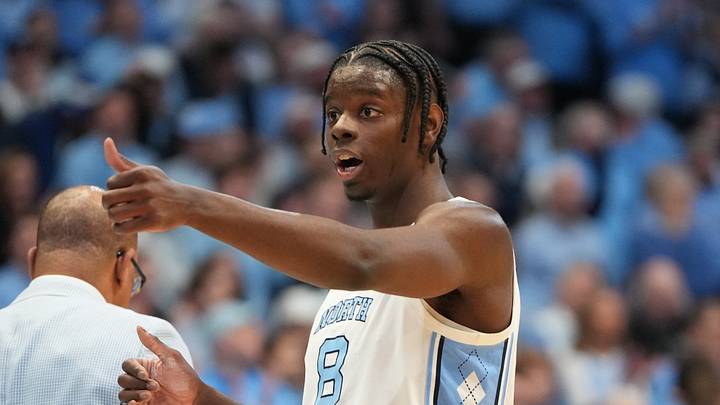
Caleb Wilson is the future of the Chicago Bulls.
Is it too early to lay such a hefty claim upon a player that clearly has a lot of growth to do on both ends of the court? Probably.
But with the way this rebuild has been laid out for the organization by Bryson Graham, the trajectory of the team is now on the shoulders of this 20-year-old forward. While Josh Giddey and Matas Buzelis are both solid pieces (and both likely have a future with the organization), neither possesses the two-way, dominant upside that Wilson does.
If Wilson can realize his upside as a defensive monster and a capable perimeter shooter and interior scorer, the Bulls suddenly have a piece they can start to construct a championship-worthy roster around. If he can't, they'll be left seeking out that type of star-level player through the rehashed Draft Lottery system.
Often, these sorts of expectations can skew the perception of a young player's rookie campaign. As much as the Bulls' future depends on Wilson's ability to realize his potential as a star, the success of his rookie season shouldn't be measured by his ability to reach that mantle in terms of his offensive production.
It's important to stay measured, therefore, in our evaluation of Wilson. If the young forward can finish 2026-27 having taken strides in his comfort with taking the ball into his hands, getting downhill, and drawing contact alongside Buzelis in the frontcourt, that should be considered a successful rookie campaign for the North Carolina product. Anything beyond that would simply be icing on the cake.
Caleb Wilson needs to stay focused on the main goal as he enters his rookie season with the Bulls
Wilson's stint in Las Vegas this summer was obviously eye-popping. He finished his Summer League debut with 35 points and seven made 3-pointers, and although his production slowed down slightly from there, we got a real glimpse at what he's capable of becoming on the offensive end.
But don't expect Wilson's sudden perimeter shooting prowess to carry over immediately to the NBA level. Wilson shot just 25.9% from beyond the arc on limited volume during his time at North Carolina, and there's still a certain degree of awkwardness in his shot that could force him to limit his perimeter attempts during his rookie campaign.
Thankfully, that's not what Chicago needs to see out of Wilson in 2026-27.
We already know what Wilson can be defensively, and training his instincts and helping him leverage his athleticism in help and off-ball situations will likely be a priority for Tiago Splitter and the rest of the coaching staff. The offensive end is where Wilson needs the most polish. This Chicago team has the infrastructure to help him accomplish that.
With the floor spacing that Norman Powell and (to an extent) Giddey and Buzelis will provide to the starting five, Wilson should have a full complement of interior and downhill touches available to him from the very start of the campaign. In the NBA, though, he'll be going against bigger and stronger defenders than he ever saw in college, and anyone who's matched up against him on the perimeter will have a wider array of physical tools to try to keep him there.
Any chance Wilson has of starting to realize his potential on the offensive end over his first couple seasons rests on his willingness to take on that contact and use his athleticism to break away from his defenders on the perimeter. If he averages, say, 18 points and knocks down 35% of his shots from beyond the arc this season, that's great.
But even if he doesn't reach those benchmarks, seeing Wilson evolve in his confidence and his fluidity with the ball in his hands over the course of the season should be the real marker of his success.
 Add us as a preferred source on Google