

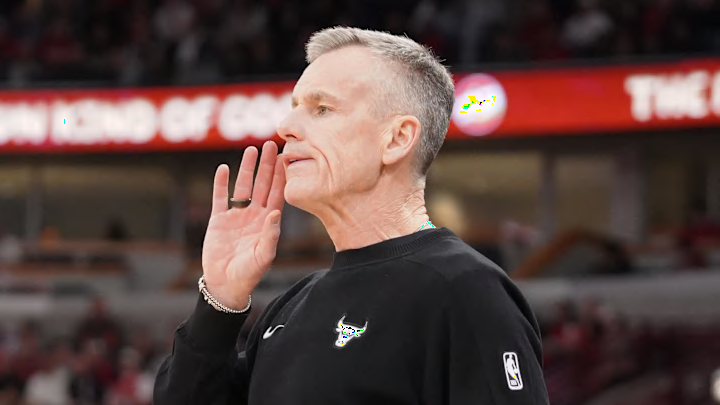
Among the 10 teams with the toughest remaining schedules, only one sits outside the top 10 in its conference: the Chicago Bulls. Chicago has the NBA’s fourth-hardest remaining slate. The next non-playoff team is the Dallas Mavericks, ranked 11th.
Consequently, the Bulls’ post-All-Star break schedule will likely be littered with "L’s." Even though Chicago has been solid against teams above .500 this season, this is a completely different Bulls team. The group that went 12–14 against tougher competition no longer exists.
Chicago added seven new players ahead of the trade deadline, the largest influx of talent in the NBA. At the same time, the Bulls moved on from eight players, seven through trades and one via release, also the most departures of any team at the deadline.
It’s essentially a new team, making comparisons to earlier results, particularly against quality opponents, difficult to draw. But continuity isn’t the only issue. Cohesion will play a major role in Chicago’s likely struggles down the stretch, as the remainder of the season doubles as a tryout period for Billy Donovan’s revamped roster.
In essence, it’s a soft tank for the Bulls. Chicago will still compete on a nightly basis, but its lack of a cohesive lineup (along with a glaring shortage of high-end talent) will likely lead to losses. Nonetheless, the Bulls aren’t the only team employing this strategy.
The Bulls and the NBA’s tanking trend
Despite adding top-tier talent ahead of the trade deadline, both the Utah Jazz and Washington Wizards have already made their short-term strategies clear. In a weekend matchup against the Orlando Magic, the Jazz lost despite leading by as many as 17 points late in the third quarter. Utah kept its new addition, Jaren Jackson Jr., along with leading scorer Lauri Markkanen, on the bench for the entire fourth quarter—a decision that ultimately contributed to the loss. Meanwhile, even after acquiring Trae Young and Anthony Davis over the past month, neither player has appeared in a game for Washington, and it’s unlikely either will this season.
While those are examples of so-called "hard tanks," they aren’t fundamentally different from what the Bulls are doing, just more apparent. And that’s not where the tanking stops. At least four or five other teams are openly eyeing improved draft positioning. It’s a problem that has drawn plenty of criticism, yet there’s no simple solution, especially after the NBA flattened the draft lottery odds in 2019.
As it stands, the bottom three teams each have a 14.0 percent chance of landing the No. 1 overall pick, and even teams in the latter half of the lottery still have a shot at a high selection. Just last season, the Dallas Mavericks jumped from 11th to first, while the San Antonio Spurs moved from eighth to second.
Dallas landed a franchise-altering talent in Cooper Flagg last season, but this year feels entirely different. There are three, arguably four or five, prospects who would be clear-cut No. 1 overall picks in another year, further incentivizing tanking. Better odds only increase the chance to land someone like Darryn Peterson, Cameron Boozer, or AJ Dybantsa.
With fewer than 30 games to go, the NBA’s tanking issue will only become more pronounced. Teams like the Bulls won’t completely avoid winning (that’s nearly impossible), but they will experiment with lineups, keep injured players out longer than usual, and prioritize the NBA Draft over the Play-In Tournament.
Chicago has long emphasized "competitive integrity," a favorite phrase of lead decision-maker Artūras Karnišovas that often drew the ire of fans. Yet this trade deadline showed the Bulls are finally prioritizing the future and effectively embracing a "soft tank" rather than the much-maligned competitive integrity that previously led to repeated Play-In appearances.
 Add us as a preferred source on Google