

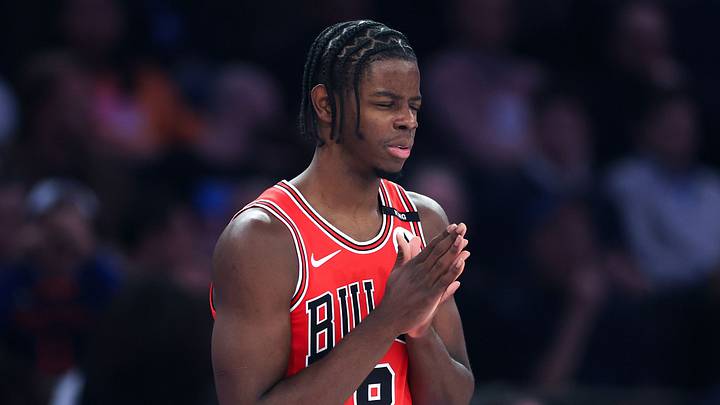
Whether or not it was their intention, the Chicago Bulls committed to a long-term build toward sustained success when they drafted Caleb Wilson at No. 4 overall. Wilson is already showcasing the ability of an NBA-caliber player, as well as a potential franchise cornerstone, but he's also making the mistakes that are simply inevitable for a 20-year-old rookie.
With this in mind, the Bulls' best path forward is to prioritize lineups that make Wilson's development easier—even if it means sacrificing wins in the present.
Chicago certainly isn't trending toward a playoff berth with a 1-9 record and a tendency to find themselves on the wrong end of a blowout. Nic Claxton beginning the season with an injury and Norman Powell picking one up along the way certainly isn't helpful, either.
For that matter, Wilson dealing with a hand injury is a clear concern for a Chicago side that already has reason to believe that the season is lost.
In saying that, the Bulls' best path forward is the same today as it was going into opening night: Prioritize Wilson. Building lineups that help him play at his best possible level is the key to not only maximizing the current roster, but building beyond this season in a way that will ultimately make the struggles worth it.
That includes starting polarizing players such as Josh Giddey and Norman Powell, who have played a direct role in Wilson's early success.
Lineups that help Caleb Wilson improve are more important than winning
An example of lineups that prioritize Wilson are those that include Powell. For instance: In 195 minutes with Powell on the court, Wilson is shooting 12.2 percent better from beyond the arc and improving his true shooting percentage by 5.2 percent.
For as difficult as it may be to see right now, that's far more important than the fact that Powell is shooting 39.8 percent from the field and 30.9 percent from beyond the arc.
Giddey is another example. He's shooting 41.9 percent from the field and 28.6 percent from beyond the arc, and has been disappointingly passive. In saying that, he's also helping Wilson make jumps of 18.4 percent in true shooting percentage and 22.4 percent in three-point field goal percentage.
The good news is that Giddey is benefiting from Wilson's presence, as well, with leaps of 1.1 points and 8.2 assists per 36 minutes when the rookie is on the court with him compared to when he isn't.
Bulls have built a roster that arguably isn't meant to compete now
Perhaps things will ultimately level out with Powell returning to the All-Star status he achieved last season—if not the high-level performances he consistently produced in the years prior. If that transpires, then Chicago should instantly improve as a team and find it easier to win games.
The same goes for if Wilson begins to put it all together in an even better way than he already has, thus becoming a more consistent leading scorer and overall player.
Even if those turnarounds never take hold, however, Chicago didn't build this roster to last. It's possible that it could, but it signed Powell to a one-year deal with a team option and brought in Claxton with just two years left on his contract.
In other words: Both Claxton and Powell arrived in Chicago with contracts, respective ages, and individual qualities that suggest they're meant more to help on the trade market than the court.
If it helps Caleb Wilson improve, it's the right answer
Powell is 33 and made the All-Star Game last season. That makes the prospect of joining a rebuilding team a tough sell. Even still, he signed with Chicago—and the team option in his deal suggests it was to help him land his ideal annual salary and for the Bulls to be able to trade him with ease.
Teams will likely be lining up to trade for Powell come February, working with the knowledge of what he can bring to the table and how a team option can either give them an out or provide the security to re-sign him to a longer deal.
Something similar goes for Claxton, who's 27, has two years left on his contract, and hasn't made the playoffs since 2023. The odds of him re-signing with Chicago are thus low if they can't build something sustainable—and Wilson is the key to that very goal.
Perhaps there are lineup structures that could lead the Bulls to short-term success, but if it comes at the expense of Wilson, it just isn't worth it.
 Add us as a preferred source on Google