

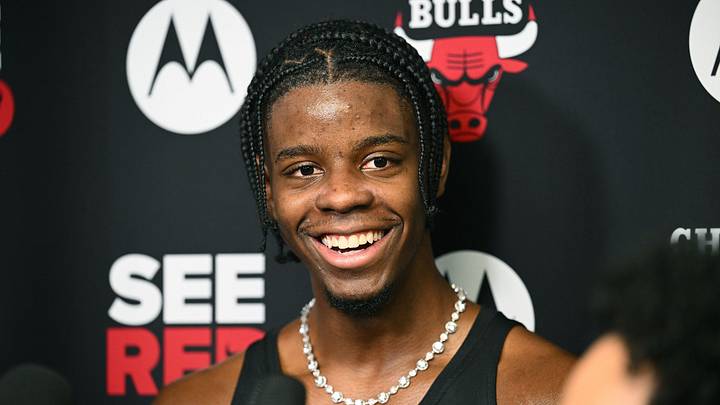
When the diagnosis was revealed that Caleb Wilson had fractured his right hand, the Chicago Bulls were 1-9 and running in circles. A poor record was arguably to be expected, but Chicago's offense was putrid, its veterans were ice cold, and Nic Claxton had played 34 minutes all season. Much has since then changed.
When Wilson ultimately returns from the surgery he underwent to repair the fracture, he'll be joining a Bulls team that should be far better suited to support his development.
In the six games since Wilson's last appearance, Chicago has gone 3-3 with wins over the likes of the Atlanta Hawks and Minnesota Timberwolves. One of its losses was an overtime instant classic against the Denver Nuggets and each of the other two were close and competitive games.
One of the key differences has been Claxton getting close to 100 percent, as he's appeared in four of the Bulls' past six games and played upward of 20 minutes in three of them.
Furthermore, Norman Powell shot at a clip of .398/.309/.797 prior to Wilson's injury and has since shot the lights out at .500/.394/.667. Throw in Matas Buzelis' scoring average jumping from 13.5 over the first 10 games to 17.8 over the past six, Buddy Hield turning back the clocks, and Josh Giddey turning in his two best games of the season, and Chicago has plenty to smile about.
That's all resulted in Chicago going from ranking No. 25 in offensive rating through 10 games to No. 11 over the past six. In no time at all, the Bulls have given Wilson something to look forward to.
Bulls overburdened Caleb Wilson, but they're turning things around
A first-year player has inherent hurdles that make the challenge of adapting to the NBA difficult enough. Add the fact that Wilson's more experienced teammates had seemingly forgotten how to play at the level that made them who they were and his first 10 games created a monumental burden.
Through 10 games, all three of Buzelis, Giddey, and Powell were shooting 42.9 percent or worse from the field—and Wilson was left to pick up the slack.
The result was Wilson having to attempt a team-leading 16.2 shots per game. Powell was second at 12.9. They were the only two players on the team averaging even 10.0 shots per contest, and the inefficient Buzelis and Giddey were third and fourth at 9.8 and 9.3 respectively.
If all were going well, that could've been an understandable formula on offense. Considering Wilson was being forced to take shots he had no experience attempting to simlpy save the Bulls from ending up on the wrong end of a blowout, however, it was unsustainable.
It also resulted in the Bulls losing five of their first 10 games by double figures, with each loss coming by at least 14 points and three being by at least 30.
Bulls are actually hitting open shots, playing competitive basketball
The important context here is that the Bulls didn't simply become a better team without Wilson because he was holding them back. Their last two games with him, for instance, were a six-point loss to the now 14-3 Philadelphia 76ers and a five-point loss to the now 14-3 San Antonio Spurs.
What's transpired over the past six outings, however, has been a general shift toward better and more efficient basketball—and one of the key factors is that players are simply hitting the shots they weren't making before.
Chicago ranked dead last in the NBA in field goal percentage on wide open shots during the 10 games that Wilson played. Since his injury, they're No. 4 in the same statistic. With a team that's simply remembering what it's capable of, Wilson will have a chance to join a significantly stronger unit than the one he inherited.
In the process, Wilson can return to the Bulls and turn in a rookie season that may come with its share of challenges, but ultimately positions him to learn without consistently being overburdened.
 Add us as a preferred source on Google