

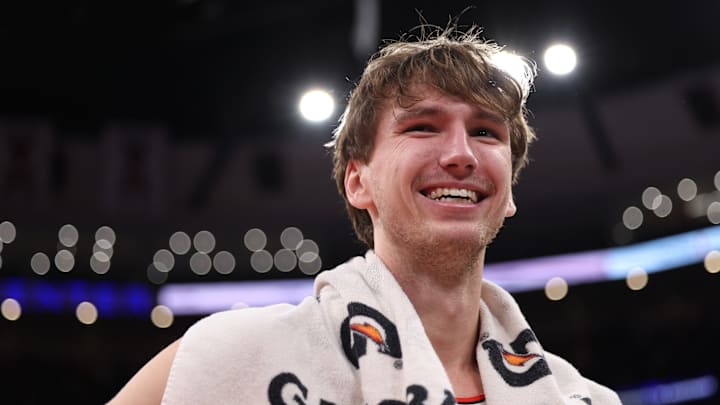
Being an NBA player is a lot like riding a roller coaster. There are ebbs and flows. Not every game is optimal, and at times it can feel like a free fall. That’s just the reality of the league. Even perennial MVP candidates have their off nights. No exceptions.
That constant up-and-down is often most apparent in sophomore players. After a rookie season—whether it goes well or poorly—they have just one year of NBA experience as the measuring stick for their career. Are they exceeding expectations, meeting them (which isn’t always ideal), or falling short?
Matas Buzelis got off to a rocky start
For the Chicago Bulls’ lone sophomore and most prized prospect, the recent returns have been encouraging. Matas Buzelis is exceeding expectations… but it hasn’t always looked this way.
From the beginning of the season, Buzelis was one of the most tantalizing players in Chicago and across the league, held to a standard that even Billy Donovan eventually had to lower.
Still, the Buzelis hype was impossible to ignore after a strong preseason and an impressive start to his sophomore campaign, during which he averaged 16.0 points in October. But just as it wasn’t kind to the Bulls, November proved rocky for the 6-foot-9 wing. His scoring dipped to 12.2 points per game, his field goal percentage fell to 44.0 percent, and his suspect point-of-attack defense was put under the spotlight.
The growing pains were impossible to miss, and the once lofty, if not delusional, idea that Buzelis could earn an All-Star bid all but vanished. Then came December. The 21-year-old began to regain his footing, a turnaround that coincided directly with the Bulls’ improved play. After starting the month 1-5, Chicago finished December at 7-7. Buzelis averaged 15.4 points, 4.6 rebounds, and 1.3 blocks while shooting 52.7 percent from the field.
Buzelis hitting his stride as 2026 begins
While December was promising, it pales in comparison to Buzelis’ recent surge. Through early January, he’s averaging 21.3 points, 6.7 rebounds, 4.0 assists (!), 1.0 blocks, and 2.3 three-pointers per game, while converting 50.0 percent of his field goals and 35.0 percent of his attempts from deep.
With Josh Giddey missing all three January games and Coby White appearing in just one on a minutes restriction, Buzelis’ usage rate has jumped from 20.0 to 26.5. He’s been driving more to create opportunities instead of just looking to score, adding more variety to his shot diet, and getting to the free-throw line more often.
Just as the Bulls needed someone to step up with Giddey out and White nursing calf tightness, Buzelis delivered. But it’s not just about the backcourt injuries. He’s finding his footing at the perfect time in the season—about a month before the trade deadline. Chicago isn’t a bona fide seller (even if they arguably should be), but with seven players on expiring contracts, that possibility is looming. If the Bulls do sell, Buzelis could assume an even more prominent role, and he’s showing he’s capable of thriving in it.
Chicago has known it has a cornerstone, but most NBA players’ progressions aren’t linear. Buzelis won’t necessarily improve every game, and he’ll experience his ups and downs. Still, the 21-year-old is beginning to find consistency, which is a promising sign for both his development and the Bulls’ future.
 Add us as a preferred source on Google