

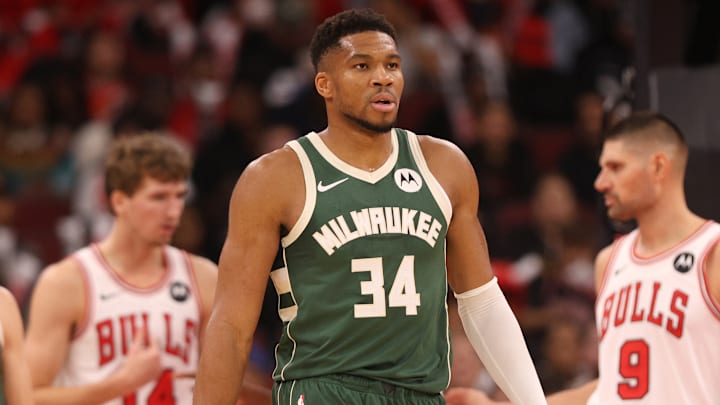
Could Trading Matas Buzelis for Giannis Antetokounmpo ever make sense for the Bulls?
The whispers are out there again. The possibility—the dream—of landing Giannis Antetokounmpo has resurfaced, and speculation in some corners suggests that the best package Chicago could offer might include their prized young forward, Matas Buzelis.
The repercussions of a Giannis mega-trade
It sounds exciting: a tried-and-true superstar paired next to a budding guard core. But before fan hopes get carried away, the real question is: is this a smart leap—or a desperation dive? This isn't an outright "never trade for the Greek Freak" screed. Instead, it's a caution-toned reflection, a reasoned breakdown of why such a blockbuster may look flashy—but could also jeopardize everything the Bulls are building.
I. The Timeline Mismatch
Giannis is no longer a young up-and-comer—he's 31 as of 2025 and under contract for the next several seasons, with cap hits of about $54.1 million in 2025-26. Meanwhile, Buzelis is just 21, the kind of athletic long-term asset modern front offices hold onto as the foundation of a multi-year core. That's a fundamental mismatch in timelines. Combine a 30-plus-year-old superstar—whose prime years are already partially spent—with a raw young core, and you risk having a "two-timeline" team: one built on immediate shotmaking, the other built on future development.
If Giannis declines physically in 2–3 years—whether through wear and tear, injury, or age—the result could be nothing but empty glory and the loss of long-term potential. What's more: trading away Buzelis (and likely other assets) could leave the Bulls without a young foundation. Should the Giannis gamble fail, there is no guarantee that the "next generation" will pick up the pieces.
II. Supporting Cast & Depth—What would be left?
A superstar like Giannis never comes cheap. It's rarely "just" one player. Reports indicate that unrealistic demands for a blockbuster would likely include more than one core piece, and perhaps several draft picks—not to mention salary matching. If the Bulls were to send out Buzelis—and maybe other rotation players—plus picks and matching salary, what remains around Giannis and their young backcourt might be little more than minimum-contract fillers.
Depth becomes a huge question. In a league where injuries, wear and tear, and roster turnover are constant, a thin supporting cast is often the death knell for "win-now" pushes. Past star-for-assets trades serve as cautionary tales: even if the top talent delivers, a lack of surrounding pieces often leads to collapse under pressure, especially in playoffs. There's no reason to assume the Bulls would be different.
III. On-Court Fit: Giddey, Giannis... and Space?
One of the biggest obstacles to this hypothetical pairing is floor spacing and fit. Giannis thrives around the rim—his attacking paint presence draws help. But that help demands shooters around the perimeter. Meanwhile, a guard like Josh Giddey—recently locked into a 4-year deal—needs spacing and driving lanes to run the offense.
If a trade for Giannis involves sending away shooters, forwards who stretch the floor, or spacing bigs, the offense could become clogged. Without real three-point shooters and perimeter spacing, the Giannis-Giddey experiment could collapse into inefficient half-court sets or forced isolation plays—completely negating the perceived upside.
On the upside: if the spacing is solved, the combination could be terrifying. Giannis kicking out from the strong paint presence, Giddey orchestrating in transition—that's a physical, fast, downhill attack that few teams could survive. And defensively, Giannis solves many of Chicago's interior issues (rim protection, rebounding, help defense), something fans have read about in previous rebuild-oriented pieces. But that upside requires perfect construction. And perfect construction remains elusive.
IV. Opportunity Cost: What you give up vs. What you could build
The Bulls today are sitting on something most teams envy: youth, draft capital, cap flexibility, and a developing core. They don't need to "win now" under pressure. By holding onto Buzelis, picks, and financial flexibility, they could build intelligently—fill out the roster with 3-and-D wings, defensive centers, complementary shooters—and wait for the stars to align.
Alternatively, they might chase a younger max-level free agent (age 26–28), offering upside and longer control, without bleeding their core or draft stock. A Giannis-for-whatever-the-cost-might-be trade is a form of hype trade. It turns a seemingly thoughtful long-term rebuild into a short-term sprint. And in the NBA, sprints rarely withstand the pace of wear, injury, and the long grind of seasons.
V. Emotional and Organizational Context: The risk of chasing flash
For many fans, the thought of Giannis in a Bulls jersey might be cause for instant hope, perhaps even a shortcut to relevance. We've seen that movie before: quick trades, immediate expectations, disappointing seasons. Distant and recent memories of past rebuilds, band-aid trades, and short-term fixes make this feel dangerous.
From the front office perspective, making a splashy move could feel like saving face—but it could also erode long-term credibility. Building a culture around youth, development, and defensive identity requires patience. Betting it all on a 30-plus-year-old superstar could jeopardize that foundation.
VI. What We Know Right Now: Giannis' real value & trade realities
. Giannis' 2025-26 contract cap hit is roughly $54.1 million. For any franchise, absorbing that salary—plus balancing the trade package—is a massive undertaking. Rumors in 2025 suggest Giannis might be exploring his options. But even among contenders, many front offices are showing caution. After years of splashy moves and cap inflation, trading away multiple first-round picks and young core members for one star is increasingly viewed as overly risky.
For Chicago, that means their offer—young assets, cap flexibility, and a clear timeline—might actually be more attractive than some "win-now" packages. But only if both sides are willing to bet on long-term stability over short-term glory.
VII. Conclusion: A risky proposition, not a panic move
Trading Buzelis (and more) for Giannis is a high-stakes gamble. The upside—a legitimate contender built around a superstar—is tempting. A Giannis-plus-Giddey tandem, surrounded by shooters, could be dangerous. But the risk is enormous: lost youth, depleted depth, cap burden, and a fading championship window once Giannis' decline begins.
The Bulls don't need to cash in their future for hype. They can keep growing their youth core, maintain flexibility, draft wisely, and build a real foundation. If they succeed, they'll be contenders—not just for one season, but for a sustained window. If they trade for Giannis, they're betting it all—and hoping a single star tips the scales in their favour. That's the difference between a calculated rebuild and a desperate leap.
For now? The safe, smart path is clear: retain Buzelis. Let the future wait. Let it build.
 Add us as a preferred source on Google