

The Chicago Bulls made so many trades ahead of the February 5 deadline that it’s hard to keep track of who’s still on the roster. At this point, it’s easier to assume that anyone who opened the season in Chicago is gone. That reality was on full display in the Bulls’ 124–105 loss to the Boston Celtics on February 11, when only three players who had logged minutes before February saw the floor. The rest of the rotation consisted of seven recent trade acquisitions.
The Bulls are a franchise in transition
This is a team in transition. Chicago is prioritizing its future by preserving salary cap space while also figuring out which recently acquired players can be long-term keepers.
The Bulls have already identified two players likely to stick around beyond this season: Jaden Ivey and Rob Dillingham, both of whom are under team control for multiple years. Ivey is technically a restricted free agent, but Chicago retains the ability to match any outside offer. Meanwhile, new additions Anfernee Simons, Collin Sexton, Guerschon Yabusele, Leonard Miller, and Nick Richards project more as short-term placeholders than long-term building blocks.
Yet Chicago had an opportunity to secure another inexpensive potential building block—and nearly did—before rerouting him out of desperation. That player was Ousmane Dieng, whom the Bulls briefly acquired in the trade that sent Coby White to the Charlotte Hornets.
Chicago passed on Ousmane Dieng’s upside
Dieng, along with a future second-round pick, was initially traded from the Oklahoma City Thunder (the team that drafted him 11th overall in 2022) to the Hornets in exchange for Mason Plumlee. Shortly after, he was sent to Chicago along with Collin Sexton, only to be rerouted again to the Milwaukee Bucks in exchange for Nick Richards.
The Bulls, needing size, seemingly prioritized Richards over Dieng despite the six-year age gap and the upside of an underutilized former lottery pick. Chicago had only one healthy center available prior to the swap (Jalen Smith) so the move didn’t come entirely out of left field.
Still, for a team without a clear direction and seemingly banking on something, anything, breaking its way in the future, why not take a chance on the 22-year-old Dieng? Sure, adding a 6-foot-9, 185-pound wing may feel redundant after drafting Matas Buzelis and Noa Essengue in back-to-back years, but in today’s NBA, you can’t have too many lanky, two-way wings.
Moreover, four years into his career, Dieng remains more of an idea than a finished product. He has appeared in just 138 games and owns career averages of 4.3 points, 2.1 rebounds, and 1.0 assists, shooting 42.6 percent from the field and 31.2 percent from three. But he has also spent that time with one of the league’s most dominant teams in recent seasons, the Thunder, who happen to be loaded with wing depth.
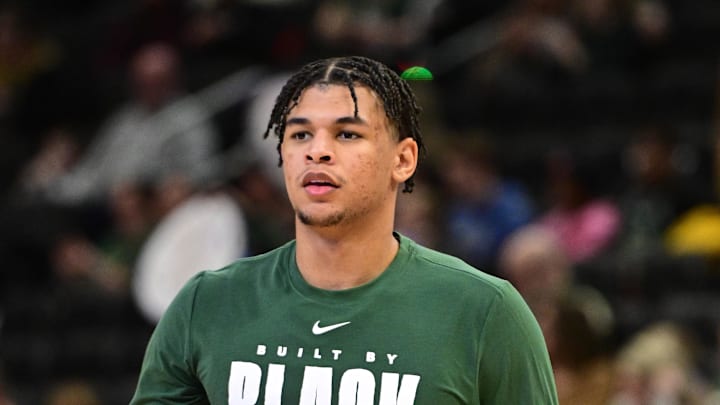
Like former lottery pick Dillingham in Minnesota, Dieng wasn’t given much of a chance in Oklahoma City. In Chicago, he likely would have received that opportunity. Instead, the 22-year-old wing has now landed in Milwaukee, where a meaningful role appears available as well.
Dieng has played just two games for the Bucks, but he flashed his potential in Milwaukee’s February 11 win over the Orlando Magic. The Frenchman scored 17 points and grabbed three rebounds in 23 minutes, shooting 5-of-8 from beyond the arc.
Ousmane Dieng lit it up from long range.
— Milwaukee Bucks (@Bucks) February 12, 2026
17 PTS | 5 3PM | 63% 3FG pic.twitter.com/2DWjD3MbyG
The risk the Bulls didn’t take
It’s not that Dieng is outplaying Richards in Chicago. The 28-year-old big man has been solid, averaging 10.7 points, 5.7 rebounds, and 1.7 blocks across three appearances. The issue is that this may simply be Richards’ ceiling. Six years into his career, we know who he is: a capable backup center who rebounds well, finishes around the rim, sets hard screens, and provides drop coverage with some rim protection.
There’s nothing wrong with Richards as a backup center. But rerouting Dieng so quickly already feels shortsighted, and it could look even worse if the 22-year-old strings together more performances like his 17-point breakout for a depleted Milwaukee roster.
After all, Richards could very well be a one-year rental, whereas Dieng, like Ivey, is a soon-to-be restricted free agent. While he would technically come off the books this offseason, Milwaukee retains the right to either sign him to an extension or bring him back on a qualifying offer for a fifth season. It’s a low-risk, high-upside scenario for one of the league’s older rosters.
 Add us as a preferred source on Google