

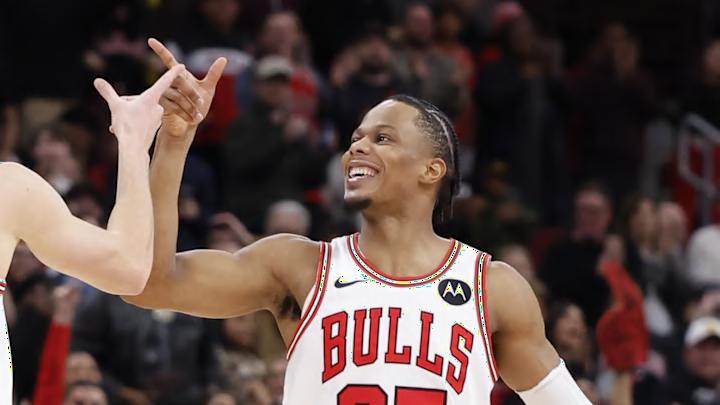
After what felt like months of anticipation, trades have finally started rolling in. The Chicago Bulls, Cleveland Cavaliers, and Sacramento Kings teamed up to kick off trade season. Chicago played the role of facilitator as the Cavaliers acquired Keon Ellis and Dennis Schröder, while DeAndre Hunter landed in Sacramento. In return, the Bulls netted two future second-round picks, sending out two-way signee Emanuel Miller and absorbing Dario Šarić in the process.
While minor, the trade is a win for the Bulls, who stepped into a facilitator role to acquire draft capital. It won’t move the needle in the short term unless Chicago uses its newly acquired picks to pursue talent ahead of the deadline. Still, it’s a savvy move for a front office that has generally neglected to stockpile draft assets.
Bulls have leaned on player-for-player swaps
Chicago has largely leaned on player-for-player swaps in recent years. While those deals often feel underwhelming on the surface, they’ve paid off for the Bulls. The Alex Caruso–for–Josh Giddey trade, widely ridiculed at the time, has turned into a major win for Chicago. Giddey has emerged as a borderline All-Star and played a central role in reshaping the Bulls’ offense.
Yet, the Caruso-for-Giddey swap isn’t the only deal that has paid dividends. At the start of the 2025 offseason, Chicago sent fan-favorite Lonzo Ball to the Cavaliers in exchange for former fifth-overall pick Isaac Okoro.
From the outset, this trade wasn’t viewed particularly favorably either. Chicago had just moved a proven contributor in Ball, whose offensive and defensive versatility is difficult to overstate. In return, the Bulls acquired Okoro, a player who had seemingly regressed over the past few seasons.
While Ball’s numbers didn’t jump off the page during the 2024–25 campaign, he was afforded some grace as he returned from the knee issues that sidelined him for more than two seasons. Even so, the 6-foot-6 guard averaged 7.6 points, 3.4 rebounds, 3.3 assists, and 1.3 steals per game in a reserve role.
However, Ball’s injury issues persisted, limiting him to just 35 games in his return season. That lack of availability ultimately prompted Chicago to move on. The return initially felt light, especially given that the former UCLA standout was once believed to carry first-round value.
Bulls win as Okoro fits and Ball struggles
Fast forward to February 2026, and that late-June trade looks like an absolute steal for the Bulls. Okoro isn’t lighting up the box score, averaging 8.7 points, 2.7 rebounds, and 1.5 assists per game, but his defensive versatility and efficient, low-maintenance offense have been invaluable. He has routinely taken on the opposing team’s top guard or wing and has shot well enough from beyond the arc (35.4 percent) to command defensive attention.
Ball, meanwhile, is down to 4.6 points, 4.0 rebounds, and 3.9 assists per game while shooting a brutal 29.9 percent from the field and 26.9 percent from three. Among 450 NBA players on standard contracts, Ball ranks 460th in field-goal percentage. It sounds made up, but it isn’t—Ball is having a rough season in Cleveland.
Thus, the Cavaliers moved to bolster their backcourt by acquiring Ellis and Schröder. With starting point guard Darius Garland battling injuries this season, Cleveland needed a more reliable option behind him. Now, with two former Kings in tow, Ball appears to be on the way out less than a year into his Cavaliers tenure.
All told, the Bulls clearly came out ahead in the Lonzo Ball trade. Ball’s struggles in Cleveland only reinforce how smart the Bulls’ front office was in making the swap, proving that sometimes the real winners of a trade aren’t immediately obvious—they become clear with time.
 Add us as a preferred source on Google