

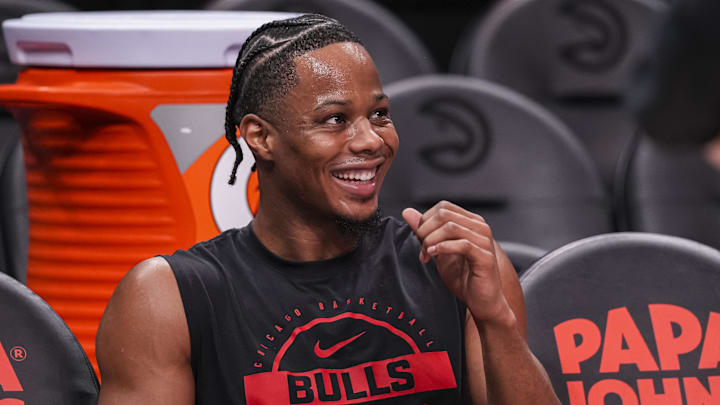
It would be fair to assume the Chicago Bulls’ trade deadline most benefited a new arrival. After all, they added a league-high seven players, reshaping their roster in a matter of days.
Still, while there have been flashes from the Bulls’ newcomers, none have dramatically shifted the team’s trajectory. Anfernee Simons, acquired from the Boston Celtics, leads the group at 15.2 points per game, while Guerschon Yabusele has provided a solid 10.6 points and 6.3 rebounds after a quiet half-season with the New York Knicks.
The rest of the newcomers have offered mixed returns. Collin Sexton is averaging 12.3 points per game but shooting just 41.9 percent from the floor. Jaden Ivey will miss the next two weeks with knee soreness, while Leonard Miller has logged only 12 total minutes. Nick Richards has been a steady, if unspectacular, reserve big, and Rob Dillingham has seen more opportunity in Chicago than he did in Minnesota, but is averaging just 7.8 points on 35.5 percent shooting.
It wasn’t essential for the Chicago Bulls to add immediate difference-makers at the deadline. The focus was on future salary flexibility, draft capital, and low-risk bets on once-promising talent. Still, that doesn’t mean no one benefited from the flurry of moves.
Isaac Okoro’s post-deadline surge
The real beneficiary of the Bulls’ deadline chaos? Isaac Okoro. The Bulls' starting small forward has seen both his role and his production spike since the roster shakeup.
February has marked Isaac Okoro’s most productive stretch of the season. He’s averaging 11.8 points, 3.4 rebounds, 1.9 assists, and 1.1 steals per game (all season highs) while knocking down 4.0 field goals, 1.5 three-pointers, and 2.3 free throws per contest. The increased output has coincided with a usage jump from 12.4 in January to 15.6 in February.
Okoro looks far more confident offensively. He’s hunting his shot, creating off the dribble, and consistently getting to the free-throw line. The surge has translated into results, too. He’s matched the longest double-digit scoring streak of his career with six straight games in double figures.
There’s still seemingly more to unlock in Okoro’s offensive game. In February, he’s averaging a season-high 5.0 drives per game and converting an eye-popping 69.2 percent of those attempts. Among 146 players averaging at least five drives per contest, that efficiency ranks fourth league-wide. It's been a dramatic leap for a player who had not previously averaged more than 3.0 drives per game or shot above 50 percent on them in any month this season.
Okoro is also creating more for himself. In February, 31.3 percent of his baskets have come unassisted, up from 20.6 percent on the season. Whether it’s growing confidence or increased comfort within the Bulls’ system, the reshaped role created by the trade deadline is clearly fueling his offensive expansion.
The Bulls may not have added a star at the deadline, but their offseason gamble on Isaac Okoro is starting to look shrewd. His defense has been steady all season. Now, with his offensive game expanding, he’s emerging as something more than a one-dimensional player.
 Add us as a preferred source on Google