

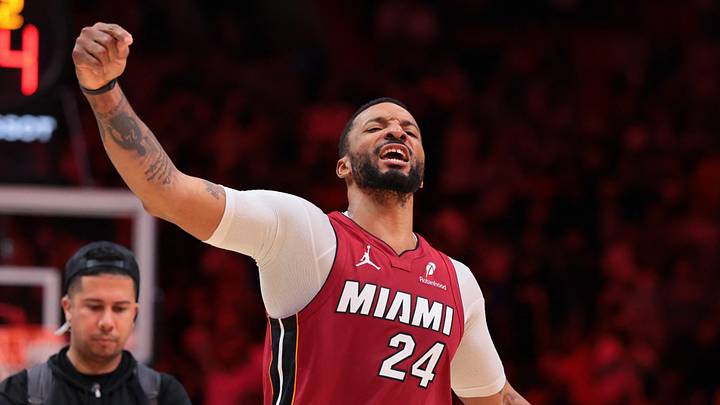
The Chicago Bulls, on the whole, have had a highly successful offseason.
With a new lead executive in Bryson Graham, a long-term vision of defense and athleticism has consistently been preached since the season came to an end. That vision was implemented in the NBA Draft, with the Bulls taking Caleb Wilson at fourth overall and Dailyn Swain at 15th.
But the Bulls did more than establish a young core this offseason. They absorbed Nic Claxton into their cap space via trade to fill their lingering need at center. They also added Norman Powell and Zach Collins on 'balloon-style' deals with team options that should make them attractive trade candidates by the time we reach the deadline.
For Chicago, the immediate mission extends beyond just amassing young talent. They need to leverage what tradeable assets they have to collect future draft capital.
The goal, therefore, should be to move Powell this season. But he'll need a major campaign production-wise in order to garner the trade market Chicago is likely hoping for.
The Bulls' offeason is hinging on Norman Powell's eventual trade market in 2026-27
From a perspective of immediate competitiveness, the Powell signing should be a major boon for the Bulls. Across 58 games with the Miami Heat last season, the veteran guard averaged 21.7 points, 3.5 rebounds, and 2.5 assists while shooting 38% from beyond the arc. He was named to the first All Star Game of his career, and he became a majorly important starter for the Heat over the course of the season.
Chicago needed a backcourt partner for Giddey, especially one who could help space the floor and provide another offensive outlet. Powell presents that in abundance. For a team that's looking to avoid the basement of the standings and take advantage of the NBA's new '3-2-1' lottery system, that type of talent is invaluable.
But Powell's contract isn't designed for him to be a long-term contributor for this team. He'll make $21.5 million across his first season in Chicago, but the second year of his deal— which will come in at $22.5 million— is not guaranteed. This means that, for any team looking to trade for him in-season, he essentially represents an expiring salary.
Teams are always looking for additional perimeter shooting at the deadline. If Powell can bump his numbers from beyond the arc closer to the 40% we saw with the Los Angeles Clippers in 2024-25 and 2023-24, even on the high volume he'll see in Chicago, there will be teams willing to aggregate salaries to bring him in. The Boston Celtics come to mind, depending on how Payton Pritchard fills their void at shooting guard. The Detroit Pistons could have a similar need, although their contracts may not allow them to complete that sort of deal in-season.
Powell's efficiency didn't drop significantly with an enhanced role over the past two seasons. Without a concretely defined offensive structure in Chicago, there's room for him to get virtually unlimited touches in the early portions of the season. Those are both positive signs for Powell's eventual trade market.
But if the Bulls are going to maximize the return on their Powell signing, they'll need him to remain consistent, healthy, and productive over the course of the season— something that hasn't been a guaranteed throughout his career. Chicago's offseason isn't a failure if this doesn't come together, but the Powell signing is certainly a cornerstone of Graham's short-term vision.
It would be excellent if it paid dividends at the trade deadline.
 Add us as a preferred source on Google