

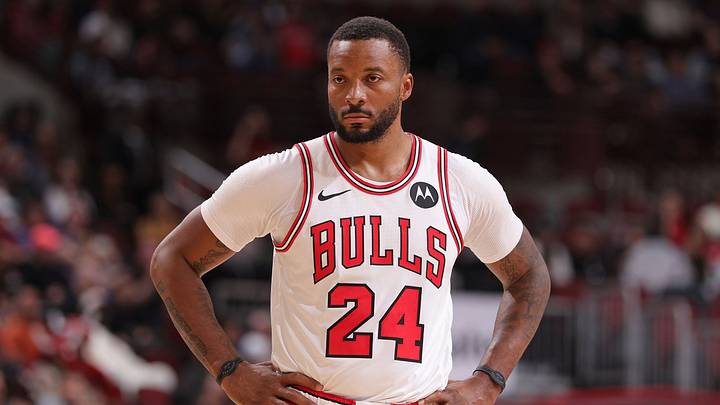
The Chicago Bulls made one of the more surprising signings of the summer when they landed Norman Powell on a two-year, $44,075,000 contract. Chicago's interest in Powell was clearly understandable from a pure talent perspective, but he doesn't quite fit the timeline of their 24-and-under core as a 33-year-old veteran.
That's beckoned a pivotal question: How long will Powell's tenure in Chicago actually last? More importantly: What exactly is an ideal run for him with the Bulls?
On one hand, Powell is a sharpshooting All-Star whose volume as a scorer and ability to space the floor should simplify the game for his younger teammates. On the other, if he plays up to his full ability, there should be a robust market for his team-friendly contract at the trade deadline.
Both outcomes could yield positive results for a Bulls side that has a core of three up-and-comers and not much else in regard to known long-term commodities.
Matas Buzelis, Josh Giddey, and Caleb Wilson look the part of a promising young core, with Wilson receiving praise as a possible franchise player. All three are 24 or younger, however, and question marks still exist in regard to Buzelis and Giddey's true potential, as well as how they'll fit with Wilson.
With this in mind, the best path forward with Powell is difficult to discern—as both options could produce valuable results.
The case for keeping Norman Powell past the trade deadline
Powell is coming off of a 2025-26 season during which he averaged 21.7 points, 3.5 rebounds, 2.5 assists, 1.1 steals, and 2.7 three-point field goals made per game on .470/.380/.827 shooting. He would've been Chicago's leading scorer had he produced the same mark for them.
Though Buzelis and Wilson project to be high-level scorers themselves, Powell's proven proficiency and off-ball value suggest he can both shoulder a heavy workload individually and work off of them within the system.
Furthermore, Powell wasn't the only veteran Chicago acquired this summer. They rounded out their starting lineup with center Nicolas Claxton, which suggests there's a stronger hunger to win in the present than some might've assumed.
If that proves to be the case, then Powell's ability to both create his own offense and work an off-ball role could make him a valuable addition to a Bulls team with apparent short-term goals.
The case for trading Norman Powell at the trade deadline
For as true as that all may be, every point in favor of keeping Powell contributes more to the case for trading him. For one, teams are always looking for high-level shooters and scorers at the deadline to fill voids in their rotation. With 91 career playoff games played, Powell has proven to be that type of contributor in even high-pressure situations.
If interest in Powell does mount, there's thus a realistic possibility that the Bulls could net a first-round draft pick or even a quality young player who better fits their timeline in a potential trade.
What could make Powell even more valuable is that his contract is likely to appeal to contenders. He's making a tradable salary of $21.5 million in 2026-27, which is a key piece to any negotiating puzzle. What takes his trade intrigue over the top is the second-year team option.
Powell has a 2027-28 team option worth $22,575,000. As a number that's arguably low for his vaule on the court and easy to clear cap space with if he isn't a long-term fit, his market value could skyrocket.
The far-too-early verdict: Norman Powell is best positioned to be traded
It's too soon to know what the Bulls should do, but it seems as though Chicago showed its hand with the contract structure. This is mere speculation, but perhaps Powell was looking for a payday during a summer that saw teams struggle to come up with money for free agents. In turn, he landed with a non-contender that could pay him now and trade him later to a contending franchise.
Only nine players received higher annual salaries than Powell this summer and eight of them re-signed with their original team. The lone exception: Walker Kessler going to the Los Angeles Lakers via sign-and-trade.
Throw in the team option for a veteran who's already the arguable best present-day player on the roster and it seems as though his tenure wasn't meant to last. Instead, it appears that he was meant to be traded—with Chicago likely to benefit from such a decision.
In that scenario, the Bulls would have one of the most talented, productive, and financially safe players on the open market. The return could thus be significant.
In this scenario, Chicago could get at least one first-round pick out of a team that's on the cusp of contending and needs a player like Powell to push them over the edge. It could also prioritize pieces who have proven to have potential, but need time to develop—and can thus help the Bulls build out their development pipeline.
Time may prove otherwise, but Powell seems to offer the most value to the Bulls as a trade piece.
 Add us as a preferred source on Google