

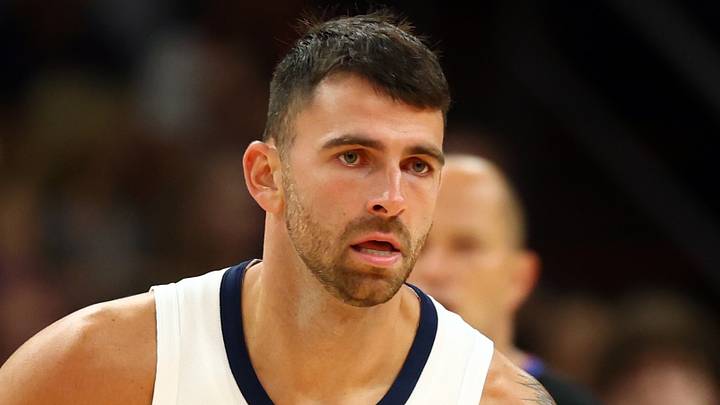
Friday, the Minnesota Timberwolves continued their expansive 2026 NBA offseason roster overhaul by trading guard Josh Green, with cash considerations, to the Utah Jazz for guard Cody Williams and wing John Konchar, ESPN’s Shams Charania reported.
The Timberwolves are expected to keep Cody Williams, the No. 10 pick in 2024, and waive-and-stretch John Konchar, sources said. They found a home for Josh Green on a Jazz team that wanted an additional 3-and-D wing; moving his $14.7 million deal gives Minnesota the salary space… https://t.co/iyikXWZjvX
— Shams Charania (@ShamsCharania) August 29, 2026
In an interesting decision by the Timberwolves front office led by Tim Connelly, the franchise made the choice to keep Cody Williams while waiving and stretching John Konchar’s remaining $6.2 million salary, first reported by Charania and officially confirmed by the franchise on Saturday.
NEWS: @Timberwolves Waive Forward John Konchar
— Timberwolves PR (@Twolves_PR) August 30, 2026
Full release:https://t.co/Rq4nrQ0ojm
Ideally, the Chicago Bulls should capitalize on the Timberwolves' questionable roster construction choice, as an NBA Western Conference franchise presumably chasing an NBA championship in the 2026-27 NBA season, and sign free agent Konchar to their 15th and final main roster spot while giving the wing a nice raise via their $9.4 million room mid-level exception.

The rub in this idea is that Konchar is a non-shooter (career 34.9% three-point percentage on 1.8 three-point attempts), and the Bulls are largely a shooting-starved roster until proven otherwise.
Surmising why Konchar was stretched
The logic behind the Timberwolves trade immediately screams financial implications for the apron-sensitive Timberwolves, who are projected to be approximately $500k under the NBA second apron threshold once their salary cap books are settled with the acquisition of Williams, along with forward Jonathan Kuminga, and the waiving and stretching of Konchar’s remaining salary, according to Spotrac.
The trade of Josh Green for Williams and Konchar allows the Wolves to effectively reduce Green’s $14.9 million expiring salary to Cody Williams’ $6 million guaranteed salary for the 2026-27 NBA season via the combination of waiving Konchar and the fact that Williams final 2027-28 contract year is a non-guaranteed team option.

Williams enters his age-22 NBA season when the 2026-27 NBA season tips off, while the season also represents Konchar’s age-30 season if he signs with another NBA team as a free agent.
So the optics of Cody Williams' upside relative to Konchar might be in play for the Timberwolves’ decision to keep Williams over Konchar.
What Konchar lacks in shooting and age is more than compensated for by his rebounding and defensive impact. Konchar, over his seven-season NBA career, averaged 1.8 steals per 36 minutes and 8.2 rebounds per 36 minutes, according to Basketball Reference.

The Bulls could make great use of Konchar’s strengths, as there will be some valid concern over the 2026-27 Bulls' rebounding based on the 2026 NBA trade deadline departure of center Nikola Vucevic and the underwhelming rebounding abilities of his presumed Bulls starter replacement, Nic Claxton.
Despite his 6’11” height, Claxton has never averaged double-digit rebounds at any point in his seven-season NBA career, and he has played a starter role in the last four seasons of his career with the Brooklyn Nets.
Rebounding aside, the Bulls going into the 2026-27 season are expected to be a bad defensive unit, so veteran leadership to build the Bulls' defensive identity from the ground up will be needed at some point in the Bulls' rebuild.
Bulls’ realized roster-building opportunity cost
Konchar not being an ideal Bulls free agent pickup is a roster-building opportunity cost that was created and inflated by Bulls lead front office executive Bryson Graham’s predecessor, Arturas Karnisovas.
Over Karnisovas’ six seasons running the Bulls front office from 2020 to 2026, four of his six roster builds finished their respective season outside the NBA top-10 rank in both three-point percentage and three-point attempts.

The Bulls were a top-10 three-point shooting team in terms of percentage and attemps for both the 2024-25 and 2025-26 NBA season, yet the nuance in those results is the Bulls top-ranked three-point shooting results of the last two seasons are as much a product of now-former Bulls (see: Zach LaVine, Kevin Huerter, Nikola Vucevic, and Coby White), as it is of any Bulls player that will suit up for the franchise during the 2026-27.
Years of Karnisovas rostering non-shooting athletes instead of building up shooting roster depth, and prioritizing Josh Giddey as a lead ball handler over Coby White have created a roster inherited by Graham that may nominally achieve serviceable three-point shooting while also lacking depth in volume three-point shooters outside of Norman Powell.

Graham did himself no favors in the volume three-point shooting department by spending his 2026 NBA offseason cap space on acquiring Claxton, extending center Zach Collins, and drafting Dailyn Swain at 15 overall in the 2026 NBA Draft. If the Bulls are truly to make progress in their rebuild, they’ll need to quickly find three-point shooting depth.
All the while, the franchise will also miss out on opportunities to make practical margin moves like adding John Konchar for defense and rebounding because of the spacing problems a shallow-shooting roster would create by adding Konchar to the mix.
 Add us as a preferred source on Google